It is hard to believe it is that magical time of year again. Thoughts turn to how we are going to celebrate the holidays. This would, of course, include decorating our living spaces. Fortunately for plant people, there are no shortage of choices for the season. Plants also make wonderful gifts to take to a holiday gathering. After all, they bring nothing but joy and cheer.
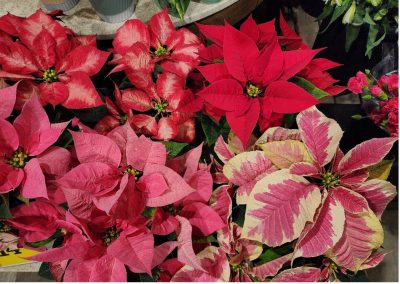
The first holiday plant that comes to mind is the poinsettia. Although native to Mexico, they seem to have found their way into every corner of the country. It is not actually flowers that are the stars of the show, but the colored leaves. What was once a beautiful red has been selectively bred for some absolutely amazing colors. My all-time favorites include a newer snow-white colored one, yellow, and the orange varieties. If two-tone leaves are preferred, there are neat red with pink centers and white with pink centers – both of which look absolutely stunning. A new one for this year has snow white leaves with a slight pink blush at the center. Of course it does not end there! There are varieties like “Jingle Bells” which looks like the red has white paint splattered all over it, which makes it a real conversation piece. The “Christmas rose” comes in many colors now and has the leaves swirled into a rose shape.
The poinsettias are beautiful, but they take a little bit of TLC to get them to stay that way. They should only be watered when they are dry to the touch on the surface. Let them dry too long, and they drop leaves. Cold drafts will produce the same result. If water is splashed on the leaves, the spots will discolor and dry, ruining the look. These plants are best watered from the bottom by filling the tray they are sitting in with water and letting the soil and roots wick it up. Poinsettias tend to fall from grace after the holiday season, and therefore are treated as a temporary decoration.
There are a number of other plants that will make just as nice of a display. The first is the Christmas cactus. They bloom profusely this time of year. They also make a great houseplant if they are allowed to dry out between waterings. To get them to rebloom the following year, put them in a room that is only illuminated by natural light – mother nature will take care of the rest (they need a critical period of darkness to flower). These plants can be so long lived that they can become family heirlooms.
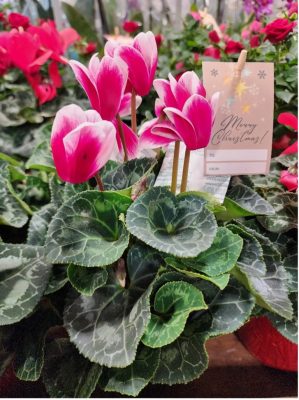
Some lesser-known plants include the frosty fern, which is not a fern at all, but a Selaginella (Spikemoss). Although some species can tolerate extreme desiccation, the species sold during the December holiday season cannot. These are great for people who love to over water because if they dry out at all, they will wither and die. They actually prefer to be in moist, soggy soil but not submerged. Cyclamen are nice looking plants with the flowers held above the leaves. These are somewhat long lasting, but tend to go dormant. They seem to be hard for most people to keep long term. Kalanchoe plants have beautiful flowers of all different colors, but these are also a challenge to keep as a long-term houseplant. Amaryllis bulbs can be beautiful when blooming, and after a dormant season may rebloom the following year. These are easy to keep provided the watering is done only while growing and not while dormant or dying back.
I do not know if it is the marketing or the colors of holiday plants that make them so popular, but do not forget about traditional houseplants for gifts. Some nice philodendrons, spider plants, pothos, or snake plants certainly make wonderful additions to any home. There are so many beautiful new varieties coming to the market all the time. No matter what plant species is chosen, plants tend to put a smile on the face of the receiver. In my opinion, there is no greater gift. If the choices are too many, then why not get a gift certificate for a local independently owned nursery or greenhouse? Happy holidays!!!
The UConn Home & Garden Education Center supports UConn Extension’s mission by providing answers you can trust with research-based information and resources. For gardening questions, contact us toll-free at (877) 486-6271, visit our website at homegarden.cahnr.uconn.edu, or reach out to your local UConn Extension Center at extension.uconn.edu/locations.