Soil Health

Should You Lime This Fall?

By. Dr. Avishesh Neupane, UConn Soil Nutrient Analysis Lab

Fall brings familiar lawn and garden jobs like reseeding thin turf, planting bulbs, cleaning up beds, and preparing for winter. For many people, lime is also a part of the fall lawn-care routine.  

But lime is not something every lawn or garden needs every year. When soil is too acidic, limestone can be very helpful. However, when the soil pH is already suitable, adding more lime provides no additional benefit and can eventually push the pH too high. Whether you should lime this fall depends less on the season than on whether your soil actually needs it. 

What lime actually does 

Limestone is used primarily to raise soil pH. Soil pH describes how acidic or alkaline the soil is, with pH 7 considered neutral. Values below 7 are acidic and values above 7 are alkaline. Soil pH affects nutrient availability, root growth, and the activity of many soil organisms. 

Many Connecticut soils are naturally acidic. Rainfall gradually leaches calcium and magnesium from soil, making it acidic. Some fertilizer practices can also increase soil acidity over time. Limestone neutralizes some of that acidity while supplying calcium and, depending on the type of limestone, magnesium. 

Most lawn grasses and common vegetables perform best in slightly acidic soil, typically around pH 6 to the mid-6s. However, there is no single ideal pH for every plant. Blueberries, rhododendrons, azaleas, and several other plants prefer more acidic conditions. Applying lime simply because the rest of the yard receives it can make the soil less suitable for these plants. 

That is why the target pH should be based on what you are growing. 

Moss does not mean “add lime” 

One of the most persistent lawn-care myths is that moss automatically means the soil is too acidic. Moss can grow well in acidic soil, but it also thrives in shade, wet or poorly drained soil, compacted areas, and thin turf where grass struggles to compete. A shaded, damp lawn may have moss even when its soil pH is perfectly acceptable. 

Adding lime without checking the soil may therefore do nothing to solve the real problem. If the lawn is heavily shaded, compacted, or poorly drained, those conditions still need to be addressed. 

The same principle applies when grass looks weak or vegetables struggle. Poor plant growth does not by itself indicate a need for lime. Problems with drainage, compaction, nutrients, watering, roots, insects, or disease can produce similar symptoms. 

How much lime? 

Knowing the soil pH is important, but pH alone does not always tell you how much limestone to apply. Two soils with the same pH may require different amounts of lime to reach the same target. Soil texture, organic matter, and the soil’s ability to resist changes in pH all influence the lime requirement. Many laboratories use a buffer test to estimate this resistance and then calculate a lime rate based on the target pH for the plants being grown. This is why a laboratory soil test that provides a lime recommendation is more useful than simply checking pH with an inexpensive home meter. 

Applying less than the recommended amount may not raise the soil pH enough to reach the desired range, while over-liming can push soil pH too high and reduce the availability of nutrients such as iron, manganese, and zinc. 

Limestone works gradually, and how quickly it changes soil pH depends partly on particle size, soil conditions, and how the material is applied. It may take six months to a year, or longer, to reach its full effect 

Calcitic or dolomitic? 

Garden centers commonly sell both calcitic and dolomitic limestone. These terms describe the limestone’s composition. Calcitic limestone primarily supplies calcium, while dolomitic limestone supplies both calcium and magnesium. If a soil test shows low magnesium, dolomitic limestone can correct soil acidity while also supplying magnesium. If magnesium is already high, calcitic limestone may be the better choice. 

Limestone can also come in different physical forms. Both calcitic and dolomitic limestone may be sold as ground or pelletized products. Pelletized lime is easier and less dusty to spread because finely ground limestone is formed into pellets. Once wet, the pellets break apart, releasing fine particles that react with the soil. 

Is fall the best time? 

Fall is a good time to apply limestone, especially to lawns, because soil moisture is usually adequate and the material has time to begin reacting before the next growing season. However, lime can also be applied at other times of year when conditions are suitable. 

For a new lawn or vegetable garden, lime can be mixed into the soil before planting if a soil test recommends it. On an established lawn, it is usually applied to the surface and allowed to react gradually. 

The key is to base liming on a soil test, not the calendar. Test the soil, consider what you plan to grow, and, if lime is recommended, apply the appropriate type and amount. 


The UConn Home Garden Education Office at the George Leigh Minor Plant and Soil Health Center supports UConn Extension’s mission by providing answers you can trust with research-based information and resources. For gardening questions, contact us toll-free at (877) 486-6271, visit our website at homegarden.cahnr.uconn.edu, or reach out to your local UConn Extension center at extension.uconn.edu/locations. 

This article was published in the Hartford Courant September 21, 2026

Do Home Gardens Need Mycorrhizal Inoculants?

By Dr. Avishesh Neupane, UConn Soil Nutrient Analysis Lab 

Walk into a garden center, and you may find bags, tubs, and packets of “mycorrhizal inoculants” shelved beside fertilizers and transplants. Their labels promise stronger roots, better yields, improved drought tolerance, and healthier plants. 

The science behind mycorrhizae is real. The more practical question is whether the product on the shelf can deliver those benefits and whether your garden needs it at all. 

What mycorrhizae actually are 

Mycorrhizae are partnerships between plant roots and certain soil fungi. The fungi extend fine threads called hyphae into the surrounding soil, increasing the area from which plants can absorb water and nutrients. In return, the plants provide sugars produced through photosynthesis. These ancient partnerships play an important role in the growth of many plant species. 

Arbuscular mycorrhizal fungi, or AMF, are the most common type of mycorrhizal fungi associated with lawns, vegetables, and many ornamentals and may be labeled “endomycorrhizae.” Tomatoes, peppers, corn, squash, beans, grasses, and many flowers form these partnerships. Other plants rely on different mycorrhizal fungi. Oaks, birches, hickories, and many conifers commonly associate with ectomycorrhizae, while blueberries and rhododendrons form ericoid mycorrhizae. The inoculant must therefore be compatible with the plant. 

What may already be in your soil 

In many established garden beds, lawns, meadows, and landscapes, resident mycorrhizal fungi are already present. Their abundance and diversity depend on vegetation, disturbance history, fertilizer use and soil conditions. Adding a commercial fungus to an established soil community does not necessarily improve a partnership that is already functioning. The introduced fungi must still be alive, compatible with the plant, and able to compete with the organisms already there. 

Recent research gives gardeners good reason to be cautious. A meta-analysis published in the journal New Phytologist found that roughly 80% of commercial inoculant treatments resulted in minimal or no mycorrhizal root colonization. A separate 2025 evaluation from the University of Zürich of sixteen commercial products found that none of the seven products marketed for home gardening successfully established mycorrhizal symbiosis under controlled conditions. 

There are several possible reasons. Mycorrhizal fungi are living organisms and may lose viability during storage. Fungal species also differ in their ability to associate with particular plants and perform under different soil conditions. Independent quality standards and verification remain limited, making it difficult for consumers to know how many viable fungal propagules remain in a product by the time it reaches the garden. 

When inoculation may help 

Inoculation is most plausible where suitable fungi are scarce or absent, such as in some severely disturbed construction soils, degraded sites, or soilless and pasteurized growing media used for containers and greenhouse transplants. Even then, the plant must be capable of forming the partnership, and the product must contain viable fungi that are compatible with that plant. 

Tree and shrub plantings require extra caution. Many woody species rely mainly on ectomycorrhizal or ericoid fungi rather than AMF, so a generic product labeled “mycorrhizae” may contain the wrong organisms for the plant. Read the label carefully and look for the fungal type and species included, not just the word “mycorrhizae.” 

Why established gardens often see little benefit 

For an established Connecticut vegetable garden or perennial bed, several factors work against a bagged inoculant paying off. 

First, the soil may already contain a functioning fungal community. Introduced strains often struggle to establish in soils with diverse resident organisms. When they do establish, they may persist, decline, or alter the existing community, so their effects are not automatically beneficial. 

Second, high phosphorus commonly reduces AMF colonization and the plant’s reliance on the partnership. Many long-established vegetable gardens test high in phosphorus after years of compost, manure, or fertilizer applications. A soil test is especially useful before buying an inoculant or adding more phosphorus. 

Third, some common crops generally do not form functional mycorrhizal associations. These include broccoli, cabbage, kale, cauliflower, mustard, and radish. Beets, chard, and spinach are also generally considered non-hosts. Applying a mycorrhizal inoculant to a bed planted mainly with these crops is unlikely to provide a meaningful benefit. 

Supporting beneficial fungi 

For most established Connecticut gardens, lawns, and landscapes, mycorrhizal inoculants may not be necessary because beneficial fungi are often already present. They may be more useful in highly disturbed soils or growing media where compatible fungi are scarce. 

Good soil management can help support the fungi already in the soil. Avoid unnecessary tillage, which can break fungal hyphae, and keep living roots in the ground when practical through perennial plantings or compatible cover crops such as annual ryegrass and crimson clover. Test the soil before adding phosphorus, since high phosphorus can reduce the plant’s reliance on mycorrhizae. 

Before buying an inoculant, consider whether improving soil conditions and supporting the existing fungal community may be the better first step. 

The UConn Home Garden Education Office at the George Leigh Minor Plant and Soil Health Center supports UConn Extension’s mission by providing answers you can trust with research-based information and resources. For gardening questions, contact us toll-free at (877) 486-6271, visit our website at homegarden.cahnr.uconn.edu, or reach out to your local UConn Extension center at extension.uconn.edu/locations.   

This article was published in the Hartford Courant August 9, 2026

What to Know Before You Buy Topsoil

By Dr. Avishesh Neupane, UConn Soil Analysis Lab

The word topsoil suggests rich, dark earth that will fix most of what ails a yard. Maybe the lawn never recovered after construction, a new raised bed needs filling, or a bare patch by the driveway still looks more like gravel than garden. Buying a load of topsoil seems like a simple answer to all three. 

But "topsoil" is not a guarantee of quality. Depending on the source, it may be dense, low in organic matter, full of stones, or simply a poor match for the job you have in mind. That means homeowners should buy it with a clear idea of what it can and cannot do. 

The first question is not what to buy, but what problem you are trying to solve. If the real issue is low pH, low fertility, or some other imbalance, another load of soil may not help much. A soil test is an inexpensive way to check pH and nutrient levels before you start adding products. 

If you are filling a new raised bed, topsoil alone is usually not the best answer. A blend of topsoil and finished compost works better than straight compost or straight mineral soil, because the two materials do different jobs. Topsoil provides mineral content, structure, and weight. Compost adds organic matter, holds moisture, and improves tilth. Most unamended topsoil is low in organic matter, which is why a topsoil-compost blend is usually more useful for gardens and landscapes. 

There is no state-run topsoil grading or certification system in Connecticut, so buyers have to ask a few questions on their own. Where did the soil come from? Has it been screened? Is it meant for lawn repair, general grading, or a vegetable garden? Is compost already mixed in, and if so, how much? These answers matter because soil products are not interchangeable: material sold for grading can be fine for filling low spots but a poor choice for a vegetable bed. 

It is also worth thinking about what might come along for the ride. Poorly sourced soil can carry contaminants that are not obvious to the eye, including residues from past land use. Ask the supplier about the soil's origin, and if there is reason for concern, have it tested for lead or pesticide residues before planting. If the product includes compost, ask whether it comes from a reputable testing program, such as the U.S. Composting Council's Seal of Testing Assurance, which requires routine testing for heavy metals and pathogens. There is a biological concern as well. Invasive jumping worms and their cocoons can hitch a ride in soil, compost, mulch, and potted plants, so buying from reputable sources and using heat-treated compost or mulch when possible can help reduce that risk. 

Texture is another simple check. If the material feels sticky and heavy when wet, it may seal up and drain poorly. If it feels very light, peaty, or woody, it may settle quickly after a season or two. Good garden soil, or a good topsoil-compost blend, should crumble easily, drain reasonably well, and still hold moisture. It should smell earthy, not sour or strongly ammonia-like. 

Cost deserves a clear-eyed look as well. Bulk soil is usually cheaper than bagged soil and creates less plastic waste, but the cheapest load may not be the best buy if it leaves you with hard, low-organic-matter material that won't support plant growth well. 

There is one more caution, mainly for gardeners who refresh beds every year. Building organic matter in a tired soil is a good idea, but more compost and manure are not always better over the long run. Repeated heavy additions, especially of manure-based compost, can push phosphorus levels well above what plants can use. That is a problem for water quality if the soil erodes, and it can throw off the balance of other nutrients. A periodic soil test is the best way to know whether a bed actually needs more material. 

For most homeowners, the best results come from matching the material to the job. Test first if you can. Use topsoil for structure and volume, compost for organic matter, and each where it makes sense. For a raised bed, start with a soil-compost blend. To repair a lawn after construction, plan to build organic matter over time with compost, mulch, and returning grass clippings or shredded leaves to the soil. When buying from a bulk supplier, ask questions before the truck shows up. 

Topsoil can be a useful tool, but it is still only one ingredient. Better soil is built, not delivered in a single truckload. 

The UConn Home Garden Education Office supports UConn Extension’s mission by providing answers you can trust with research-based information and resources. For gardening questions, contact us toll-free at (877) 486-6271, visit our website at homegarden.cahnr.uconn.edu, or reach out to your local UConn Extension Center at extension.uconn.edu/locations.       

This article was published in the Hartford Courant May 17, 2026

Microplastics in Garden Soils: Should Homeowners Worry?

By Dr. Avishesh Neupane, UConn Soil Nutrient Analysis Lab

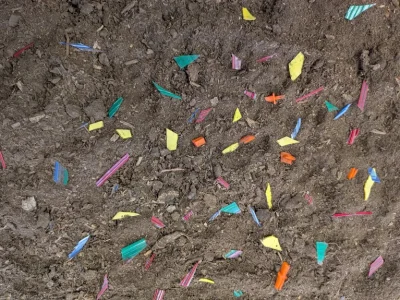
Colorful plastic fragments scattered across dark soil.
Photo by Avishesh Neupane

If you spread compost on your garden this year, there is a good chance you added a little plastic, too. Researchers around the world are now finding microplastics – tiny plastic fragments and fibers smaller than a grain of rice – in garden soils and compost products that look perfectly normal to the naked eye. In one recent study of commercial composts, every single one of the 11 products tested contained microplastics, with cleaner, eco-labeled brands still showing lower but measurable levels.

That raises a fair question for Connecticut homeowners: Should you worry about microplastics in your yard? The short answer is don’t panic, but don’t ignore it either. Microplastics are not a crisis that should send you ripping out your raised beds, but they are a good reason to be mindful about how plastic moves through our gardens and to be choosy about what we bring in.

Where are microplastics coming from?

Microplastics in garden soil mostly come from everyday sources. Composts and organic fertilizers made from mixed municipal waste or sewage sludge can carry plastic fragments and fibers, and biosolid-based fertilizers have been identified as a major pathway for microplastics into farm and lawn soils. Plastic-coated, slow-release fertilizers can contribute microplastics as their coatings weather and break down. In yards and gardens, plant tags, synthetic twine, netting, and landscape fabric can also fragment into tiny pieces when mixed into soil or added to the compost pile. On top of that, particles from tire wear, litter, and degraded plastics elsewhere can settle out of the air or arrive with runoff.

What they mean for your yard and produce

Scientists are still figuring out the full story, but some patterns are emerging. Lab and greenhouse studies show that plastic particles can affect earthworms and microbes and, in some cases, reduce seed germination, root growth, and nutrient uptake. What this means for a typical Connecticut backyard is still being studied, and while the highest documented levels of microplastics are in intensively treated farm soils, we don’t yet have enough data to say exactly how home gardens compare. Based on what we know so far, microplastics don’t appear to be an immediate emergency in your yard, but they are a good reason to take soil seriously and to reduce plastic input wherever you can. You can’t control every particle that drifts in on the wind, but you can control much of what you deliberately put on your soil and avoid adding unnecessary plastic to a system you want to keep healthy for decades.

One of the biggest questions for homeowners is whether these particles enter food crops in significant amounts. While lab studies show that tiny plastic particles can interact with roots and potentially enter plant tissues, scientists are still working to understand how often this happens in a typical backyard and what it actually means for human health. For now, most scientists emphasize source control, i.e., reducing inputs, as the most practical step. That is something gardeners are already good at: choosing better materials, building healthy soil, and asking hard questions about what they buy.

Practical steps to reduce plastic in your garden soil

Simple shifts in what you apply to your yards can greatly reduce microplastic inputs. Be choosy about compost and soil amendments. Ask what went into bagged or bulk compost, and favor products made from yard waste, leaves, or clean food scraps over those blended with municipal solid waste or sewage sludge. Avoid fertilizers and composts listing “biosolids,” “sewage sludge,” or “municipal residuals,” which are known sources of microplastics. Rethink plastic-coated fertilizers, as their coatings break down into microplastics. Keep plastic out of your compost stream by removing plant tags, synthetic twine, and landscape fabric scraps whenever you can. Skip thin plastic mulches and cheap fabrics and use shredded leaves, wood chips, cardboard, or durable, reusable barriers. And don’t underestimate your own leaves and grass clippings; they are low in plastic, build organic matter and structure, and improve soil without adding new plastic sources. We may not be able to garden without any plastic in the 21st century, but we can make sure that the soil under our feet isn’t quietly becoming a plastic landfill in slow motion.

How Connecticut is already acting on related concerns

Connecticut has not yet written microplastic standards for garden products, but the state has moved aggressively on a closely related issue. As of October 1, 2024, Connecticut banned the use or sale of any soil amendment made from biosolids or wastewater sludge that contains PFAS (per- and polyfluoroalkyl substances, a group of persistent “forever chemicals”), and on July 1, 2025, extended the ban to PFAS-containing biosolid fertilizers. Those laws are aimed at chemicals, not microplastics, but they target many of the same products. To read more about this law, read our article here.

The UConn Home Garden Education Office supports UConn Extension’s mission by providing answers you can trust with research-based information and resources. For gardening questions, contact us toll-free at (877) 486-6271, visit our website at homegarden.cahnr.uconn.edu, or reach out to your local UConn Extension Center at extension.uconn.edu/locations.

This article was published in the Hartford Courant February 7, 2026

Five Soil Myths That Cost Home Gardeners Money

By Dr. Avishesh Neupane, UConn Soil Nutrient Analysis Lab 

Every spring, I see the same scene in garden centers. Carts piled high with lime, fertilizer, gypsum, compost-in-a-bag, and something in a shiny package that promises instant results. When I chat with home gardeners, I often ask: How did you decide you needed all of that? Most of the time, the answer is, “I don’t really know. It looked helpful.” As someone who works with soil tests every day, I see the other side of that story. I see the lawn with three times more phosphorus than it needs. The vegetable bed that gets lime every year, even though the pH is already high.  

A lot of this comes down to a few myths that are passed down by neighbors, family, and well-meaning advice on the internet. But they quietly drain gardeners’ wallets and sometimes weaken the very plants people are trying to help. Here are five of the most common myths, and what to do instead.  

Myth 1: If my plants look okay, I don’t need a soil test.

Plants will try their best in less-than-ideal conditions. By the time plants show clear distress, the problem is often advanced. pH has drifted far from the ideal range. One nutrient is so high that it is starting to interfere with others. In the lab, I see plenty of samples from landscapes that “seem fine,” where the numbers tell a very different story. I also see the opposite. People are convinced their soil is terrible, but the test says they are in good shape and only need minor tweaks. 

This myth costs money because skipping the test means guessing. Guessing leads to buying products you do not need and missing the changes that would help the most. A better approach is to test your soil every few years, or sooner if you are starting something new. A good test provides clear recommendations matched to what you are growing. 

Myth 2: More fertilizer equals better plants.

People worry they are not fertilizing enough, so “a little extra” feels like good insurance.  Extra nutrients do not automatically translate to extra health. Instead, excess fertilizer can burn roots and foliage, push lush but weak growth that attracts pests and disease, and wash into streams and lakes where it fuels algae blooms, harming the environment. 

This myth costs money as you are paying for nutrients your plants cannot use. You may also pay later for disease control or to repair damaged turf and stressed garden beds. A better approach is to view soil test recommendations as a ceiling, not a suggestion to exceed.   

Myth 3: You should lime your soil every year.

Many people learned that you “always lime the lawn in the fall.” As many native New England soils are naturally acidic, lime can be important in the right amount and in the right places. But I also see plenty of tests where pH is already in the upper 6s or above 7, and the lawn is still getting lime out of habit. 

When pH gets too high for the plants, iron and other micronutrients become less available. Acid-loving plants like blueberries and rhododendrons struggle. This myth costs money twice. First, you pay for lime, then you may pay to fix the problems caused by a high pH. A better approach is to test soil pH and apply only when it is recommended.  

Myth 4: Adding sand will fix heavy clay soil.

Clay dries slowly in spring, sticks to tools when wet, and can feel like a brick when dry. A bag of sand looks like an easy fix, but mixing a little sand into a lot of clay does not make loam. It often makes something closer to concrete. What truly helps clay is organic matter. Compost and well-rotted manure can loosen heavy soils, improve drainage, and support healthier soil structure and biology. 

This myth costs money because you buy sand, haul it around, and see little improvement. For most home gardens, adding organic matter works much better.  

Myth 5: Bagged topsoil or garden soil is always an upgrade.

Big bags and bulk deliveries of “topsoil,” “garden soil,” or “planting mix” can feel like a shortcut to perfect beds. Sometimes they are excellent, but at other times they are basically subsoil with a nicer name, which can cause problems like high salt levels, unbalanced nutrients, or a pH far from the target. 

This myth costs money because poor-quality material means paying twice. Once to bring it in, and again to correct it. A better approach is to ask suppliers what is in the mix and how it is produced. And whenever possible, improve the soil you already have.  

The Common Thread

The common thread in all five myths above is that we reach for products before we understand the soil. If you start with a test, you can skip lime when your pH is already in range, cut back on fertilizer where nutrients are high, and put your time and money into the changes that will actually move the needle. That is better for your plants, your budget, and the rivers and lakes downstream. Your garden does not need every product on the shelf. It just needs the right help at the right time. 

 The UConn Home & Garden Education office supports UConn Extension’s mission by providing answers you can trust with research-based information and resources. For gardening questions, contact us toll-free at (877) 486-6271, visit our website at homegarden.cahnr.uconn.edu, or reach out to your local UConn Extension Center at extension.uconn.edu/locations.

This article was published in the Hartford Courant January 4, 2026

Road Salt and Your Soil

By Dr. Avishesh Neupane, UConn Soil Nutrient Analysis Lab

When I was a graduate student from Nepal living in New Haven from 2012 to 2014, I kept noticing the same winter aftereffect across town. Along busy streets, the first foot of lawn by the pavement turned yellow and matted, and the road-facing sides of yews and hollies burned while the yard sides looked fine. Coming from a place that does not spread salt each winter, it felt backward. We made the road safer, but the plants and soil paid the price. At UConn’s Soil Nutrient Analysis Lab, we hear versions of this every spring. People send soil from a strip along the road or from a bed near the driveway and say that spot never greens up like the rest.  

You have also likely noticed the symptoms. Fine particles form a crust on the soil surface where water evaporates. Turf browns right at the pavement edge. Buds on the roadside of a shrub fail to break. Evergreens brown on the street side when traffic spray carries salty water, while the interior needles stay green. Vegetable beds that sit too close to plow piles can exhibit poor emergence, tip burn, or slow growth, even when the rest of the garden appears fine.  

What road salt does to soil 

Sodium chloride (rock salt) is the most widely used deicer. Once it dissolves, it separates into sodium (Na⁺) and chloride (Cl⁻). Chloride is highly mobile. It moves with meltwater, so in a wet spring, it can leach through the soil and, where conditions allow, reach groundwater, affecting well water quality. 

Sodium changes how soil behaves. In healthy soil, calcium and magnesium sit on exchange sites; repeated sodium inputs displace them, sealing the surface, reducing infiltration, and making the soil feel tighter right where plants already struggle. Sodium also competes with potassium uptake, so salt-burned spots can look nutrient-deficient even when tests show adequate levels. 

Alternatives to sodium chloride are often less harsh but cost more. Magnesium chloride and calcium chloride melt at lower temperatures but still add chloride and can injure plants and corrode concrete and metal. Calcium magnesium acetate (CMA) is chloride-free and generally gentler, yet it’s pricier and harder to find. 

Lab testing and management options 

If you inform the lab that the sample is from a salt-affected area (such as a roadside, plow pile, or splash zone), they will interpret the numbers with that history in mind and, if necessary, use the appropriate salinity method for your sample. 

  1. Soil pH and texture (and organic matter). Sandy roadside fill flushes salts quickly but is more susceptible to damage due to its low buffering capacity. Heavier soils with more organic matter hold up better but can crust at the surface after repeated salting. For optimal plant health and reduced salt uptake, aim for a pH of approximately 6.5–7.0; your report will include a lime rate if your pH is below this range.
  2. Soluble salts / electrical conductivity (EC). EC shows how salty the root zone was when you sampled. It is most informative right after winter or snowmelt, when salts are near the surface. For mineral soils, labs typically measure EC from a simple soil–water extract. 

    Dense green shrub with numerous small, bright red berries growing along its branches, situated against a brick and white wall in a landscaped area.
    Plants like the Winterberry Holly (Ilex verticillata) may be able to stand up to some salt exposure in the landscape. Some varieties may be more resistant than others. (Photo by H. Zidack)

    Start with prevention. Before winter, top-dress the first 1–2 feet along the road with a thin layer of compost to improve structure and exchange capacity. Keep that strip covered, overseed thin turf, or use a salt-tolerant edge, and ask the plow operator to place piles where meltwater drains to the street or to vegetation that isn’t over your well line. Where meltwater goes matters as much as how much salt you use. 

    After winter, fix what the season left behind. If the roadside sample shows elevated EC, lightly loosen any compacted or crusted soil so that water can infiltrate. Then, leach the area with two or three deep soakings a few days apart to push salts below the main root zone. If a hedge or shrub burns on the roadside year after year, consider moving it back or replacing the front row with more salt-tolerant plants. 

    For chronic hotspots, shift from one-time flushing to long-term protection: use less deicer, keep piles away from beds and wells, maintain dense groundcover in the first foot along pavement, and in harsh exposures, consider stone mulch plus seasonal compost topdressing to help the soil rebound. 

    If your well water tastes salty, check the state’s road-salt guidance and contact your town. When the damage is limited to curb strips or driveway beds, soil testing and better winter practices usually solve it.  

    The UConn Home & Garden Education Center supports UConn Extension’s mission by providing answers you can trust with research-based information and resources. For gardening questions, contact us toll-free at (877) 486-6271, visit our website at homegarden.cahnr.uconn.edu, or reach out to your local UConn Extension center at extension.uconn.edu/locations. 

    This article was published in the Hartford Courant November 23, 2025