American beeches have been suffering from beech leaf disease that is widespread in both Connecticut landscapes and forests. The prognosis for this disease is currently uncertain, but research is investigating treatments and other methods for possible control. This disease is evident from dark bands appearing on the leaves, so homeowners can to some extent seek help from licensed arborists once this symptom is evident.
Meanwhile, beech bark disease is also becoming a major threat to American beech (Fagus grandifolia) in eastern North America. This disease is a result of an interaction between a scale insect and one of two Nectria fungal pathogens. When these scales are present, beech bark disease has an increased chance of infecting the tree. The scale responsible was introduced from Europe and first appeared in Nova Scotia around 1890, according to researchers. Within forty years, the fungal pathogen combined with heavy infestations of the beech scale were killing trees, although only in Eastern Canada and Maine.
The scale insect, Cryptococcus fagisuga, will attack American beech, European beech (Fagus sylvatica) as well as Chinese and Oriental beeches, F. enleriana and F. orientalis, respectively. The scale insects pierce through the thin bark of the beeches with a stylet and inject enzymes to help digest the plant material. These small wounds in the tree can now be the entry point of fungal pathogens, including the two native Nectria spp. that can cause beech bark disease.
Adults mate and females lay eggs in mid- summer. Eggs hatch from late summer until early winter and form a waxy white covering. These scale insects often go unnoticed until they develop a “woolly” appearance which is evident in the winter. The immature scales overwinter on the tree, and the next year will become adults. If you notice white woolly scale insects on beeches, especially on trunks, these are likely the beech bark scale. In two to three years, scale populations can reach high levels where the trunks may appear white. Scales do not have wings, but they can be blown by the wind to new trees or transported by birds or even humans.
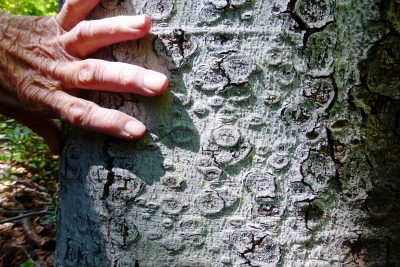
Disease symptoms take several years to develop after scales appear. Anyone hiking through the forests of Connecticut has probably noticed disfigured bark caused by the Nectria pathogens responsible for beech bark disease. In severely infected trees, living tissue just beneath the outer bark is killed. Cankers appear looking like rough, raised, circular disks. Fungal fruiting bodies appear in the center of these raised circles. Sometimes there are so many red fruiting bodies of the fungus that large areas of the trunk appear red. Over time, bark may crack and split off. Trunks of weakened trees can snap in high wind events. Nectria kills areas of woody tissue, sometimes creating cankers on the tree stem and large branches which in turn weaken the tree. Infected trees can thus be susceptible to other diseases and insects.
So, this is not a happy tale, but homeowners do have some good news. Controlling the scale on any ornamental or native beeches on a property resulting in the absence of these scale insects will prevent beech bark disease. Because beech can form thick stands, thin some smaller trees out so the remaining trees will retain vigor. Make sure trees that have no scale present, and no disfigured bark are left with good space between them.
In case you may need an arborist, the Connecticut Tree Protective Association has licensed arborists that can help you assess the situation with your trees. A licensed arborist will be the best choice in any case. They will be educated in tree insect and disease problems and their solutions, if any are available. Contact the Connecticut Agricultural Experiment Station Forestry and Horticulture department for the latest news and control options for disease and insect problems. Hopefully, your beech trees will never have problems.
The UConn Home Garden Education Office supports UConn Extension’s mission by providing answers you can trust with research-based information and resources. For gardening questions, contact us toll-free at (877) 486-6271, visit our website at homegarden.cahnr.uconn.edu, or reach out to your local UConn Extension Center at extension.uconn.edu/locations.