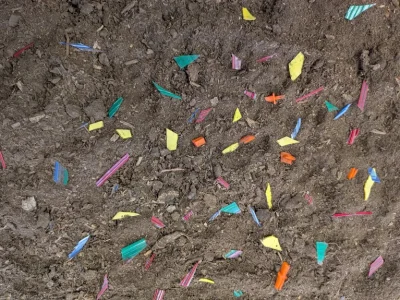
If you spread compost on your garden this year, there is a good chance you added a little plastic, too. Researchers around the world are now finding microplastics – tiny plastic fragments and fibers smaller than a grain of rice – in garden soils and compost products that look perfectly normal to the naked eye. In one recent study of commercial composts, every single one of the 11 products tested contained microplastics, with cleaner, eco-labeled brands still showing lower but measurable levels.
That raises a fair question for Connecticut homeowners: Should you worry about microplastics in your yard? The short answer is don’t panic, but don’t ignore it either. Microplastics are not a crisis that should send you ripping out your raised beds, but they are a good reason to be mindful about how plastic moves through our gardens and to be choosy about what we bring in.
Where are microplastics coming from?
Microplastics in garden soil mostly come from everyday sources. Composts and organic fertilizers made from mixed municipal waste or sewage sludge can carry plastic fragments and fibers, and biosolid-based fertilizers have been identified as a major pathway for microplastics into farm and lawn soils. Plastic-coated, slow-release fertilizers can contribute microplastics as their coatings weather and break down. In yards and gardens, plant tags, synthetic twine, netting, and landscape fabric can also fragment into tiny pieces when mixed into soil or added to the compost pile. On top of that, particles from tire wear, litter, and degraded plastics elsewhere can settle out of the air or arrive with runoff.
What they mean for your yard and produce
Scientists are still figuring out the full story, but some patterns are emerging. Lab and greenhouse studies show that plastic particles can affect earthworms and microbes and, in some cases, reduce seed germination, root growth, and nutrient uptake. What this means for a typical Connecticut backyard is still being studied, and while the highest documented levels of microplastics are in intensively treated farm soils, we don’t yet have enough data to say exactly how home gardens compare. Based on what we know so far, microplastics don’t appear to be an immediate emergency in your yard, but they are a good reason to take soil seriously and to reduce plastic input wherever you can. You can’t control every particle that drifts in on the wind, but you can control much of what you deliberately put on your soil and avoid adding unnecessary plastic to a system you want to keep healthy for decades.
One of the biggest questions for homeowners is whether these particles enter food crops in significant amounts. While lab studies show that tiny plastic particles can interact with roots and potentially enter plant tissues, scientists are still working to understand how often this happens in a typical backyard and what it actually means for human health. For now, most scientists emphasize source control, i.e., reducing inputs, as the most practical step. That is something gardeners are already good at: choosing better materials, building healthy soil, and asking hard questions about what they buy.
Practical steps to reduce plastic in your garden soil
Simple shifts in what you apply to your yards can greatly reduce microplastic inputs. Be choosy about compost and soil amendments. Ask what went into bagged or bulk compost, and favor products made from yard waste, leaves, or clean food scraps over those blended with municipal solid waste or sewage sludge. Avoid fertilizers and composts listing “biosolids,” “sewage sludge,” or “municipal residuals,” which are known sources of microplastics. Rethink plastic-coated fertilizers, as their coatings break down into microplastics. Keep plastic out of your compost stream by removing plant tags, synthetic twine, and landscape fabric scraps whenever you can. Skip thin plastic mulches and cheap fabrics and use shredded leaves, wood chips, cardboard, or durable, reusable barriers. And don’t underestimate your own leaves and grass clippings; they are low in plastic, build organic matter and structure, and improve soil without adding new plastic sources. We may not be able to garden without any plastic in the 21st century, but we can make sure that the soil under our feet isn’t quietly becoming a plastic landfill in slow motion.
How Connecticut is already acting on related concerns
Connecticut has not yet written microplastic standards for garden products, but the state has moved aggressively on a closely related issue. As of October 1, 2024, Connecticut banned the use or sale of any soil amendment made from biosolids or wastewater sludge that contains PFAS (per- and polyfluoroalkyl substances, a group of persistent “forever chemicals”), and on July 1, 2025, extended the ban to PFAS-containing biosolid fertilizers. Those laws are aimed at chemicals, not microplastics, but they target many of the same products. To read more about this law, read our article here.
The UConn Home Garden Education Office supports UConn Extension’s mission by providing answers you can trust with research-based information and resources. For gardening questions, contact us toll-free at (877) 486-6271, visit our website at homegarden.cahnr.uconn.edu, or reach out to your local UConn Extension Center at extension.uconn.edu/locations.