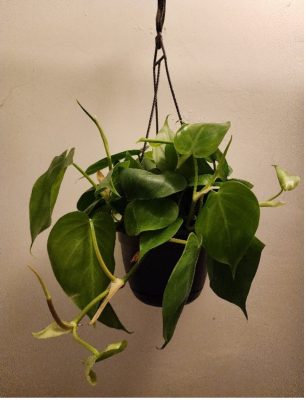
Back in the late1970s when I stumbled upon my mother’s abandoned houseplant book, I had no idea what impact that would have on my life. It was a treasure-trove of knowledge for me, and came with a gallery of some of the most common houseplants. One in particular caught my eye – the Heartleaf Philodendron. I was immediately in love (see what I did there?). All jokes aside, this was one of the biggest staples of the houseplant world, and it still is. Characterized by green heart-shaped leaves, they were commonly displayed in macramé plant hangers.
These plants, like many of our houseplants, come from humid tropical Central and South American forests. The word Philodendron comes from the Greek and means “tree lover.” This name serves as both the scientific and the common name. As one would expect, plants in this genus grow on trees in some fashion. Of course there are exceptions, but most will readily grow up moss poles if provided. A number of the species are perfectly suited to life in a hanging basket, and are commonly referred to as “trailing” to describe their growth habit. A few of my favorite trailing-types are the ones I will focus on for this article. Trailing Philodendrons are one of the easiest plants to grow and also the easiest plants to kill. The secret to their success is to not over water them. The top inch or two of the soil should dry out before they are watered again. They are very unforgiving to overwatering, and quickly develop a fungal infection that will fist cause many leaves to drop, and then the vines will wither and die. Many people see this and assume the plant needs more water, and then accidentally ensure the plant’s death. If they are put outside for the summer, I recommend hanging them under a covered porch so the watering is controlled.
The old-school Heartleaf Philodendron was just the beginning. It is known as Philodendron hederaceum by scientists. It may be incorrectly labeled as Philodendron cordatum, but this is an older/inaccurate name and beyond the scope of this article. One modern favorite variety is called Lemon Lime. As expected, it has some light green to yellow leaves in bright light. Next to the regular green, this variety really stands out. Lemon Lime is similar to one I had thirty years ago called Lemon which had only yellow leaves. There is another new one called Neon that has all yellow leaves as well. It is hard to know if these are true varieties or repackaged versions of the old Lemon with newer names. Brazil is another very hardy variety that has green leaves with a large, thick yellow stripe down the center of each leaf. There is variability in the amount of yellow in each leaf, which adds further interest to the plant. A similar but more striking variety is called Silver Stripe. This plant has a thinner stripe down the middle that is mostly cream or silver colored. This was extremely expensive last year, but is much more common and therefore cheaper now.
There are a number of different species with similar appearance and growth habits to our P. hederaceum. One of the real stand-outs is the Philodendron brandtianum, commonly referred to as the Silver Leaf Philodendron or Philodendron Brandi. The leaves are a gorgeous true silver color with green stripes following the veins. These are slower growing than the others mentioned here. By the end of last year, it was somewhat affordable in four-inch pots. I have yet to see it offered in a larger hanging basket (probably a few years away from that). A close look-a-like to this plant is the Philodendron sodiroi, which is also called the Silver Leaf Philodendron. Though less intensely silver and with paler green coloration, the leaves are larger. I finally saw one for sale last summer but passed on it as I think it was a mislabeled P. brandtianum. Nevertheless, I am sure these will be equally popular with collectors.
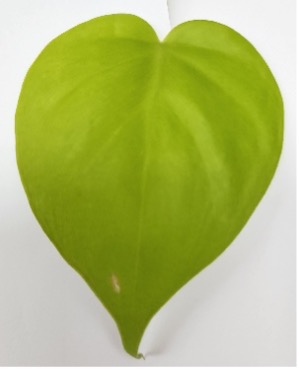
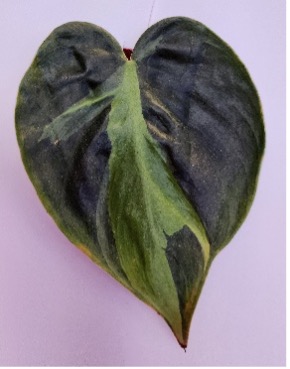
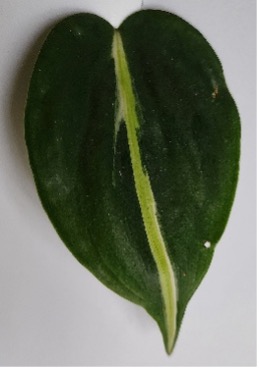
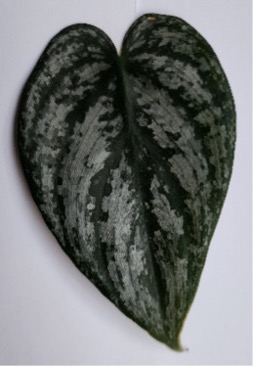
From left to right: Philodendron hederaceum ‘Lemon Lime,’ ‘Brazil,’ ‘Silver Stripe,’ and Philodendron brandtianum (photos by M. Lisy).
All of these plants are easy to propagate by cutting the stem and leaving one leaf per node. Dip it in rooting hormone and keep it in a moist, clear-bag-covered pot and in a few months, there will be new growth. Alternatively, they can be rooting in water, but I prefer the soil method as it doesn’t have to adapt from water to soil when transplanted.
I am hopeful that this article will rekindle an old flame with the Heartleaf Philodendron or its relatives. They are all generally available now in many of the big box, online, and brick-and-mortar plant stores. Why not pick one up to beautify the home for many years to come?
The UConn Home Garden Education Office supports UConn Extension’s mission by providing answers you can trust with research-based information and resources. For gardening questions, contact us toll-free at (877) 486-6271, visit our website at homegarden.cahnr.uconn.edu, or reach out to your local UConn Extension Center at extension.uconn.edu/locations.