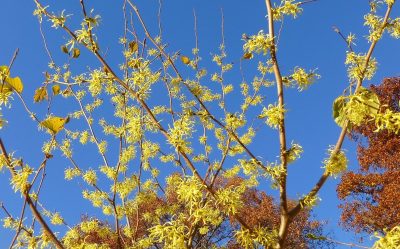
Connecticut’s native species of Witch Hazel, Hamamelis virginiana, is a remarkably unique woody ornamental that can be found as a large shrub or small tree. It comes to the rescue this time of year as the leaves continue to drop and our surroundings become starved of color. Its foliage in autumn is a showstopping yellow.
Hamamelis virginiana can grow between 10 and 20 feet tall and is often nearly just as wide as it is tall. In ideal conditions, some can even grow as large as 30 feet tall. It has a loose and somewhat open, irregular rounded shape and is very attractive in landscaping when used as hedge rows, woodland edge planting, or along a pond or river. It’s the last plant to come into bloom each year in the Northeast, blooming from October to December. The bloom coincides with its flashy fall foliage, making it one of the most eye-catching specimens of the winter landscape.
The blooms are bright yellow with spidery, ribbon-like petals and have a pleasant citrusy fragrance. They are clustered tightly around the branches, and the petals curl up protectively during cold spells. A few cut branches in a vase will be sure to perfume and brighten up your home during the dreary winter months. Its late flowers attract certain species of flies, bees, gnats, and cold-tolerant moths. These insects are a food source for native songbirds such as kinglets, chickadees, and titmice.
The medicinal qualities of the Common Witch Hazel are world renowned and have been utilized for centuries. Its anti-inflammatory properties serve as a soothing remedy for bruises, itches, sunburns, acne, and small wounds. In fact, Common Witch Hazel extract is one of the only medicinal plants approved by the FDA as a nonprescription drug. Always consult with a medical professional before incorporating the use of medicinal plants. It's worth noting that there have been several Witch Hazel processing plants in Connecticut, starting in the 19th Century. To this day, most of the world’s Witch Hazel extracts are still produced in East Hampton, Connecticut.
Consider planting a Common Witch Hazel or two in your yard, mixed with hollies, viburnums, and dogwoods for some late-season cheer. Common Witch Hazel will grow in a variety of conditions, from moist to dry, and shaded to sunny. Flowers are most abundant when planted in full sun. It prefers acidic, nutrient-rich, well-draining soil. It’s quite hardy, growing in zones 4 through 8, and has very little trouble with pests or diseases. After establishment, they are virtually care-free. The only maintenance of note is periodic pruning to remove suckers if a controlled shape is desired.
Although it is a slow growing plant, it is worth the wait when it bursts into bloom. With so much going for it, this is a plant that deserves greater consideration for use in ornamental landscapes and yards.
The UConn Home & Garden Education Center supports UConn Extension’s mission by providing answers you can trust with research-based information and resources. For gardening questions, contact us toll-free at (877) 486-6271, visit our website at homegarden.cahnr.uconn.edu, or reach out to your local UConn Extension center at extension.uconn.edu/locations.