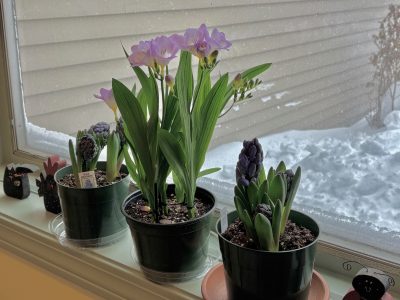
With snow covered gardens and more wintry weather on the way, many of us can’t resist the temptation to purchase potted hyacinths, daffodils, tulips, primroses and other delightful spring blooming plants to bring some early color and fragrance to our homes. It was especially difficult to leave the Connecticut Flower and Garden Show last week without an armload of plants forced into bloom.
To enjoy your plants to the fullest, here are some tips on caring for them. First realize that these plants were ‘forced’ into bloom at an earlier time than they would on their own. Growers manipulate the growing conditions of the plants by regulating temperature, light and moisture. This does stress plants somewhat so depending on the type of bulb, some may or may not bloom again.
If you have not purchased any pots of forced bulbs yet but are planning to, select ones that are still budded or ones where just a few flowers have opened. This will ensure a longer bloom period for you to enjoy. If temperatures are below 40 F, it is best to bag or wrap the plant in the store to keep the blossoms and foliage from cold injury and get the plants home as soon as possible. Leaving them in an unheated car in frigid temperatures is not a good idea.
Whether you’ve chosen to bring home spring flowering bulbs, like hyacinths, or a hardy perennial, like primroses, they pretty much all have similar requirements as houseplants. All these plants appreciate being kept in cool temperatures with between 50 and 60 F being optimum and 70 F probably being the upper limit. Warmer temperatures will cause plant growth and flowering to speed up so your blooms won’t last as long.
Bright indirect light for 6 to 8 hours of the day will keep your plants growing longer. Lately with the cloudy weather and limited sunshine, most of us can keep plants in a south window this time of year as the sun’s light is less intense and also, sparser than we would hope. Usually, the temperatures near windows are much cooler than other areas of the house.
All of these plants, as well as most other houseplants, grow best when kept moderately moist. Avoid overwatering or having pots sit in water as that can lead to root rots. I’ve noticed growers shying away from peat based potting mixes that were more moisture retentive. So, check plants every other day at first to see when they are in need of watering. While the plastic or foil pot wraps might make your selection look more appealing, they often do not have drainage holes so if pots are overwatered, the excess water stays in the wrap and the roots remain saturated and prone to rot. I like to water these plants by taking them out of the wrap, bringing them to the sink and applying enough water so that it runs out the bottom for a half minute or so and then let them sit in the sink until excess water drains out. Then return to their wrap or better yet, a saucer where excess water can be easily seen and dumped.
As far as fertilizing goes, it depends on whether you want to keep these plants and set them out in your garden when warmer weather arrives or will they get relegated to the compost or trash heap. If you intend to plant them out, then fertilize them using a half strength houseplant fertilizer every other week. The reason being you want the green foliage to photosynthesize as much as possible before the plants go dormant. The food produced by this process will enable the bulbs to sprout and grow next year. Even if not planted out, perennials like primroses will bloom for a longer period of time inside if regularly fertilized.
I have found flowering bulbs, like hyacinths and daffodils, to come back pretty successfully when planted in the garden, while having little success with tulips, unless they are species tulips or some of the smaller Greigii varieties. If keeping bulbs for planting out, remove the flower stem after blooms have faded but keep watering foliage until it starts to fade and brown. Remove the dying leaves and then the pot can be moved to a cool, dimly lit spot and just kept barely moist until the soil can be worked in the spring.
For primroses, remove the flower stalks as blossoms fade. Depending on the species purchased, your plants may or may not be hardy outside. Hopefully the plant tag will mention hardiness zones or at least give you the species so you can look it up. Primroses can be kept as houseplants but they do require cool temperatures, bright indirect lighting and regular fertilizing and watering when forming buds and in bloom. In the garden, primroses sulk in hot weather often dying back until next spring when cooler temperatures prevail.
With a little care, flowering bulbs and other plants can liven up these dreary winter days. At least they let us know, spring is right around the corner.
The UConn Home Garden Education Office supports UConn Extension’s mission by providing answers you can trust with research-based information and resources. For gardening questions, contact us toll-free at (877) 486-6271, visit our website at homegarden.cahnr.uconn.edu, or reach out to your local UConn Extension Center at extension.uconn.edu/locations.