Spring is the ultimate bringer of change. The restless souls contained within all forms of life begin to awaken, bringing fiery hues back to the formerly dreary expanse of winter landscapes. We meet this shift with a warm welcome, grateful for a chance to start anew. Innately, we crave change, constantly striving towards something greater that will fill a part of ourselves we feel is missing. Also, innately, we are walking juxtapositions. Above our desire for change floats an asterisk, denoting an extraneous condition—our deep fear of the very thing which we wish so desperately for. New experiences bring about uncertainty and inconsistency. Thus, we cling to that which we find familiar and trustworthy to ground us while careening through the unknown.
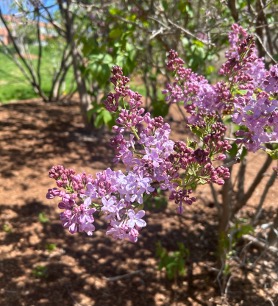
For me, ol’ reliable is the lilac shrub in my backyard. Season after season, I look out my window and am reassured by its presence, whether it is flush with vibrant blooms or displaying its tall barren branches. The leaf and flower buds of common lilac (Syringa vulgaris) are among the first whispers of spring I observe, appearing early in the season.
Members of the olive family, Oleaceae, lilacs are well suited to life in cold climates—in fact, the chill of winter is essential to their bud development and maturation. Although new plantings take a few years to adjust and establish themselves, these perennial shrubs are equipped with substantial longevity. Common lilacs can live for up to a century, cementing their place as a companion to rely on during every phase of our lives.
Common lilacs grow rapidly and immodestly, filling their landscape with a dominating sense of confidence. Success is dependent on being planted in sunny locations with moist, well-drained, and neutral to slightly alkaline pH soils.
The lilac’s blooms are dichotomous, both quietly delicate and also boisterous with a showstopping flair. Flowers emerge between late April and early May. A strong, sweet fragrance diffuses from the quaint petals which cluster together in formations called panicles. Lilac blooms appear in a variety of hues, ranging from lavender to blush pink or even a creamy white.
Even after the flowers of lilacs retire, matte heart-shaped leaves remain until the fall, painting the tall shrubs with dark green. During the dormancy of winter, gray stems and branches are visible, standing tall and proud even when cold weather casts its icy shadow over the once vibrant landscape.
Lilacs are relatively self-sufficient yet require some care and attention to maintain their vigor. Susceptible to fungal diseases like powdery mildew and septoria/pseudocercospora leaf spot, it is important to ensure proper airflow throughout plantings to discourage sporulation. Powdery mildew is characterized by gray mycelial growth on leaf surfaces, while septoria/pseudocercospora leaf spot appears as brown spots that expand into broad patches. Insect pests, namely the lilac borer and oystershell scale, also impose their will on lilacs. Borers tunnel and weave through branches, leaving holes and open wounds as evidence of their travels. Oystershell scale refers to small insects, resembling their namesake in appearance, that take refuge on lilac bark. These pests and diseases can commonly be managed through removal and destruction of damaged tissue. In severe cases, additional integrated pest management strategies may be necessary.
Consistent pruning practices are essential for lilacs to remain healthy throughout every season of change. Lilacs are beings of extreme preparation, developing next year’s buds as soon as the current flowering period is complete. By deadheading blooms promptly after they have run their course, lilacs are able to dedicate more energy to generating healthy flowers for future growing seasons. Renewal pruning is another beneficial technique—cutting back overgrown stems to remove barriers preventing light from reaching inner branches. This encourages new growth and results in lilacs which appear fuller, bursting with color from the inside out. Spring is the most appropriate time to employ these pruning tactics in accordance with lilac’s growing needs. Prune immediately after flowers start to fade for best results.
Lilacs are a cornerstone of spring, providing a familiar and reassuring sight to ground us when our own lives become unrecognizable. Lilacs and the endless wonders of spring gently remove the asterisk from our desire for change, reminding us to take solace in the familiar while welcoming all that the unknown may bring.
The UConn Home Garden Education Office supports UConn Extension’s mission by providing answers you can trust with research-based information and resources. For gardening questions, contact us toll-free at (877) 486-6271, visit our website at homegarden.cahnr.uconn.edu, or reach out to your local UConn Extension Center at extension.uconn.edu/locations.