Putting Plants Outside, Lilacs, Butterflies & Other May News

Banner reading “May 2026” centered on a dark blue panel, flanked by white spring blossoms against a blue sky on the left and three flagpoles on the right displaying the U.S. flag, a POW/MIA flag, and a UConn flag

“The month of May is the gateway to summer"

— Jean Hersey

Moving Update

The George Leigh Minor Plant & Soil Health Center move has been delayed due to unforeseen circumstances.

The Home Garden Education Office will be closed for walk-in services starting April 27th. Our target reopening date in our new location is now  May 18th. 

For the comfort and safety of our clients, our office will be closed to the public until our re-opening. Please continue to use our phone and email support during this time. If you are planning to send samples to the Plant Diagnostic Lab or Home Garden Education Office, please call ahead for shipping instructions. Thank you for your understanding.

Closures may also impact the Soil Nutrient Analysis Lab and the UConn Plant Diagnostic Lab. Please check with them directly for more information regarding closures during the move.

Due to these shifts in schedule, our May 16th Open House Event has been postponed until Fall 2026.

To accomodate for our adjusted moving timeline and a busy gardening season, our partners in the Plant Diagnostic Lab, the Soil Nutrient Analysis Lab and the Department of Plant Science & Landscape Architecture have decided to wait until Fall 2026 to celebrate our grand opening. Keep an eye out for new dates!


 When Can I Put My Plants Outside?

Green watering can on a small table surrounded by trays of seedlings on a wooden deck.

Photo by Heather Zidack, UConn Home Garden Education Office

Houseplants

To give your houseplants a refresh and encourage healthy growth, begin acclimating them to outdoor conditions for the upcoming summer. On warm days, move your plants outside, while avoiding locations that endure direct exposure to sun or harsh winds. Once nighttime temperatures are consistently above 50-60°F, it is an appropriate time to begin keeping plants outside overnight.

For plants that prefer a sunnier environment, gradually expose them to locations in direct sun over a period of two weeks. If nighttime temperatures dip below 50°F, move plants inside for the night, being sure to check for insects beforehand. 

Moving Indoor Plants Outside for the Summer

Vegetables

Cool season vegetables including leafy greens, brassicas, and root vegetables may be able to go outside before your houseplants, but they need the same care in transitioning them from inside to out.

If you have warm season plants like peppers, tomatoes or eggplant, be sure to keep them warm just a little bit longer. Peppers, especially, like warm soil and warm air temperatures to grow well.

If your plants aren't ready but you're itching to do something, consider transplanting them into 4 inch pots them so that they can continue to grow comfortably while they wait to go outside.

Keep Your Seedlings Going Strong

Hanging Baskets & Annuals

Annuals are tender and most commonly do best in temperatures similar to our houseplants. When temperatures are consistently above 50-60°F at night, they should be safe to go outside permanently.

There are some exceptions to the rule, like Pansies, and other cool season flowers that may tolerate and even thrive in lower temperatures. We still recommend taking the precautions to harden them off, especially if they were purchased from an indoor setting. 

Selecting, Hardening, and Planting Bedding Plants

Perennials & Shrubs

In most cases, shrubs and perennials should be safe to go out as soon as you purchase them. Especially if they seem to have been stored outside at the nursery. If you're walking through a greenhouse to select your plant material, it may be an indicator that it isn't ready for low nighttime temps and may be especially sensitive to late spring frosts.

First year perennials started indoors or in greenhouses may need to be hardened off, the same way tender houseplants, vegetables and annuals are.  Ask your local nursery professional if you have questions about plant readiness.

Hardening Transplants


 Interesting Insects: Tiger Swallowtail Butterflies
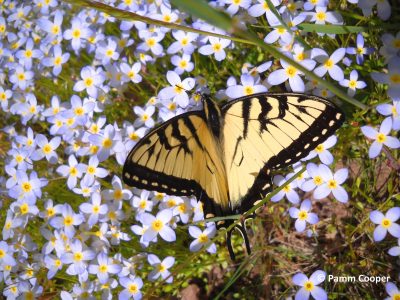
Yellow tiger swallowtail butterfly with black stirpes resting among clusters of pale bluet flowers with yellow centers in a sunlit meadow.
Pamm Cooper, UConn Home Garden Education Office

Tiger swallowtail butterflies can be seen by late April when crabapples and native little bluets (Houstonia caerulea) are flowering. They visit both flowers for much needed nectar. Bluets often form large stands on lawns and woodland edges where there is a good amount of sun. Tiger swallowtails use small black cherry and tulip trees as caterpillar host plants. They breed as early as May.

Eastern Tiger Swallowtail


 Spring is For Lilacs

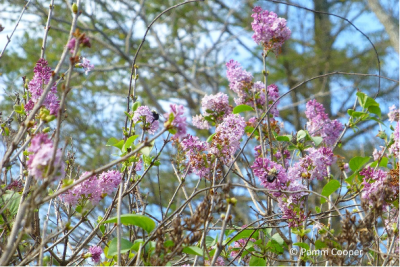
Bumblebees on fall blooming lilacs
Photo by Pamm Cooper, UConn Home Garden Education Office

To maintain the striking beauty of your lilacs for many years to come, practice regular pruning techniques. As a spring-blooming shrub, lilacs develop new buds for the next season following the current year’s flowering period is complete.
For this reason, prune immediately after bloom (often in May) to avoid removing next year’s flowers. Deadhead by pruning spent blooms promptly to promote strong flowering next year. Late spring is also the ideal time to practice renewal pruning. Cut back old growth (tall and overgrown stems) at the base, allowing light to reach previously shaded areas.

Over the course of a few seasons utilizing this technique, lilacs will appear fuller and vigorous with new shoots and flowers blooming on lower areas. Lilacs can be shaped according to your preferences by pruning during this time as well.
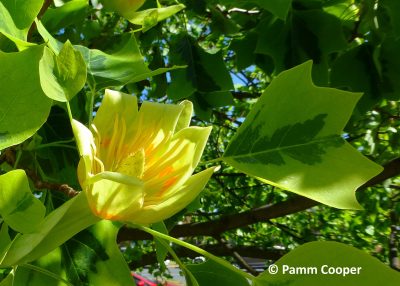

Native Plant Highlight: Tulip Tree

Yellow-green tulip tree flower with orange stamens opening among bright green, lobed leaves on a sunlit branch; a small “© Pamm Cooper” watermark appears in the lower right
Photo by Pamm Cooper, UConn Home Garden Education Office

The tulip tree Liriodendron tulipifera, commonly known as yellow poplar or tulip poplar, is a fast-growing, deciduous native of eastern North America that belongs to the Magnolia family.

It has attractive green, yellow, and orange flowers in May that resemble tulips. It is one of the largest North American native trees and sometimes reaches over 200 feet in height. Its leaves are distinctive, forming a broad, flat apex that ends at right angles to the midvein.

Learn More About Tulip Tree

The CT Native Plant Availability List: Updated and even MORE user-friendly!

This native plant guide was created to assist municipalities, conservation organizations, homeowners, landscape architects, designers, and contractors with locating native plants for habitat restoration and wildlife enhancement.

The Connecticut Native Plant Availability List, by UConn Extension and CT DEEP Wildlife Division, identifies nurseries and garden centers that grow/sell native trees, shrubs, and perennials. Along with several nurseries that are new to the list, we have also added the ability for users to view the Availability List sorted by Nursery!
CT Native Perennial, Tree & Shrub Availability List


Word from the WiSE

Women in Soil Ecology, UConn Student Chapter

Soil Mates: Finding Your Perfect Topsoil Match

From homeowners to landscapers, farmers to developers, many purchase topsoil for
their yearly plants and projects. Topsoil is the surface layer of soil, and can range in thickness from zero to twelve inches depending on how much the soil is worked. Deciding which topsoil you purchase can make or break your season, and inspection is important! Before committing to one topsoil, take a look at the soil stock pile and make sure there is no trash, large rocks, or debris. Soil texture, or the ratio of sand, silt, and clay in a soil, can greatly impact your topsoil. Some great soil textures for your topsoil include loamy sands, loams, silt loams, and sandy clay loams. Many other factors could influence the success of your topsoil, including organic matter and possible amendments. Purchasing a quality topsoil is vital to your soil health, so make sure you get the perfect match!

By Zaira O’Leary, Soil Science Master’s Student, UConn PSLA


Weather Outlook

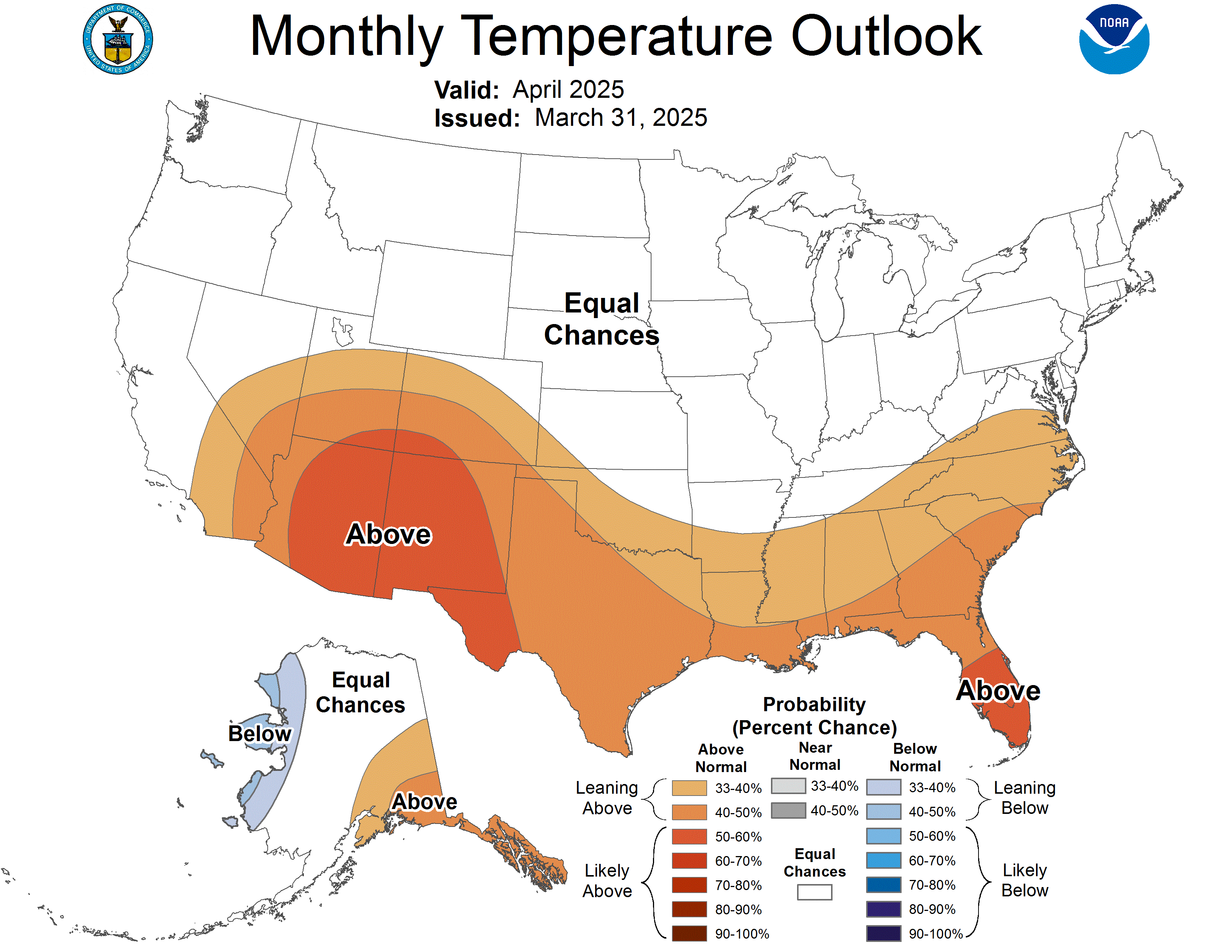
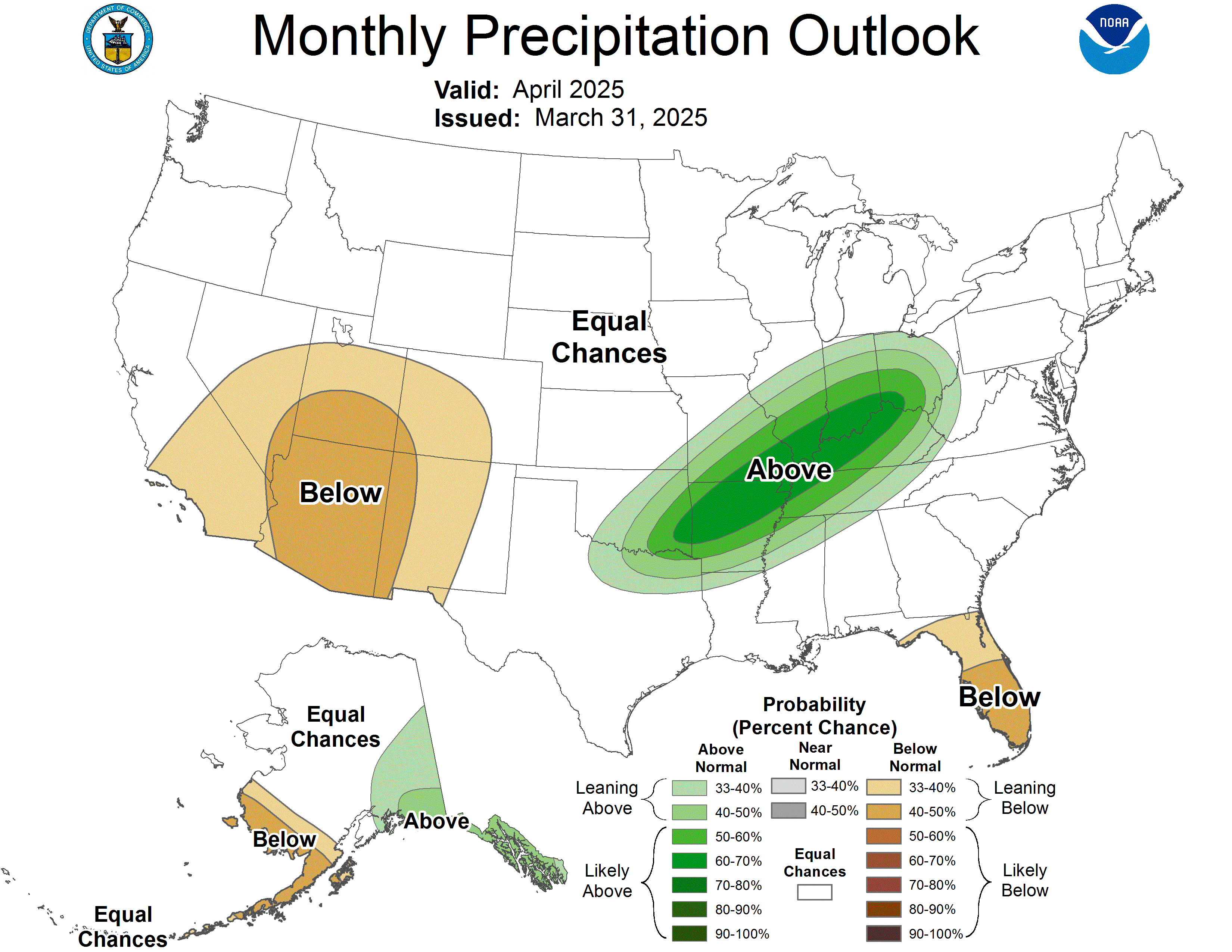
A seasoned gardener always keeps their eye to the sky at any time of year! Maps and the 30 day outlook from NOAA will help you stay prepared for any and all of your gardening chores! (Click image to see larger map.)

Monthly Temperature Outlook Map of United States
Monthly Precipitation Outlook Map of United States

We Need Your Input!

The UConn Home and Garden Education Center is asking for your input to help guide future programs and services. Please take a few minutes to complete our needs assessment survey and share what topics, resources, and support would be most helpful to you.

Your feedback will help shape upcoming educational offerings and strengthen our ability to serve Connecticut gardeners.

Thank you for your feedback!

If you have any questions about this survey, please email us at ladybug@uconn.edu

Take the Survey!


Upcoming Events and Things to Do


          Join Us at Upcoming Talks

          Gardening for Butterflies with Pamm Cooper
          May 7, 2026 - 6:00 PM
          Plainville Library
          56 East Main St, Plainville, CT 06062

          Good Bug/Bad Bug/Benign Bug with Pamm Cooper
          May 11, 2026 - 1:00PM
          Hosted by the Redding Garden Club
          Redding Community Center
          37 Lonetown Rd, Redding CT 06896


          May Gardening Tips

                • Remove spent blooms on tulips, daffodils and other spring flowering bulbs. The plant will focus its energy on growing new bulbs rather than producing seeds
                • Plant dahlias, gladioli, cannas and other summer flowering bulbs
                • Lift, divide and replant late summer and fall-blooming perennials such as asters, mums, and sedum
                • Disinfect all pots and containers before refilling them for the season
                • Check to see if your houseplants are root bound. Water them thoroughly and carefully remove them from their pots. If the roots have compacted around the outside of the root ball, it is time to repot.
                • Have frost protection fabric or cloches, such as you can buy at garden stores, ready for unexpected late spring frosts
                • Do not use a pre-emergent weed control if you are trying to germinate seeds in the same area.
                • Check family members and pets for ticks after being outside, especially when in tall grass or wooded areas. If necessary send ticks to the Connecticut Veterinary Medical Diagnostic Laboratory for testing.
                • Hummingbirds and orioles return to northern states by mid-May. Clean and refill feeders to attract these colorful birds to your backyard or fill hanging baskets with flowers that will attract them such as petunias, salvia, and fuchsia
                • Disinfect bird baths with a 10 to 1 solution of water and bleach. Rinse well.
                • Add water lilies to your pond when the water temperature reaches 70° F.


                We're Moving in May 2026

                New Location: 
                George Leigh Minor Plant and Soil Health Center
                University of Connecticut
                Roy E. Jones Building Annex
                27 Manter Road, Storrs, CT, 06269
                (In front of UConn Dairy Bar)
                Map of the Jones Annex across from the dairy bar

                UConn Home Garden Education Office

                Horticultural support and education for home garden issues related to plant health, garden pests, general plant care, and more.

                UConn Plant Diagnostic Laboratory

                Diagnosis of plant health and pest issues for commercial growers and the public.

                UConn Soil Nutrient Analysis Laboratory

                Soil chemistry testing including pH, nutrients, salinity, lime and fertilizer recommendations, and many others.

                UConn Turf Diagnostic Lab

                Turf diagnostics for golf courses, athletic fields, or other commercial turfgrass sites

                What Stays the Same

                We will continue to provide the professional and research-based support you’re used to, just in a convenient, central location. Our science-based testing protocols and result-driven recommendations reinforce our commitment to serving growers, landscapers, and the public with their plant and soil health issues.

                What Gets Better

                Combining current programs all under one roof provides an opportunity for more collaboration, outreach, and educational opportunities for our stakeholders.

                • One easy-to-find location for soil, plant, and turf sample submissions
                • Future expansion of diagnostic services available for plant and soil health analysis
                • Collaboration between programs and increased opportunities for public outreach events
                Watch for More Information Soon
                s.uconn.edu/plant-soil

                This Month’s Newsletter Contributors: 
                Pamm Cooper, Lauren Kurtz, Emily Leahy, Zaira O'Leary, Heather Zidack