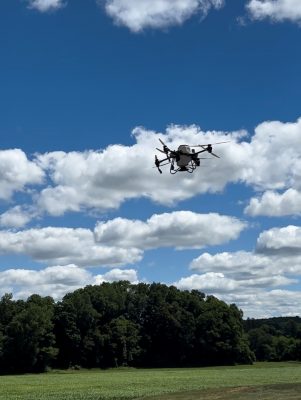
Agricultural drones are becoming more common in Connecticut and can support a wide range of farming activities. They can be used for tasks such as crop scouting and monitoring, field mapping, broadcasting seed, applying fertilizers, and precision pesticide application, where permitted and when conducted by properly licensed operators. One promising capability is the use of drones to seed cover crops.
Cover crops are plants grown to protect the soil and improve soil conditions, typically during periods where the soil would otherwise be bare, such as between cash crop growing seasons. They provide many environmental and agricultural benefits, including reducing soil erosion, capturing excess nutrients, suppressing weed growth, storing carbon in the soil, providing an additional source of livestock forage, and improving overall soil health. Planting cover crops early in the fall allows them more time to establish and grow, leading to greater ground cover and biomass production. These improvements help to maximize their benefits to the soil. In contrast, a late planting date, especially after the first fall frost, can reduce cover crop establishment, winter survival, and biomass production. Cover crops in silage corn systems are typically seeded after corn harvest using seed drills or other land-based equipment. However, in New England, silage corn harvest can extend to late October due to labor constraints, unfavorable soil conditions, and weather variability, which can substantially narrow the window for early cover crop establishment using these conventional drill-seeding methods.
Drones offer a potential alternative cover crop seeding method by enabling interseeding of cover crops, the practice of planting one crop into another crop before harvest. For example, a farmer could use a drone to broadcast cover crop seed in early fall over standing corn while it is still growing, allowing for several additional weeks of fall growth. This approach may extend the cover crop growing season without disrupting cash crop harvest. Drones can also access fields when wet soil conditions prevent ground equipment from operating after cash crop harvest, reducing compaction, and helping farmers take advantage of narrow planting windows.
Successful cover crop establishment using drones also depends on several other factors, including seed size, soil moisture conditions, and available sunlight beneath the corn canopy. Careful consideration of cover crop species selection and drone seeding timing will improve drone seeding success. Further research is needed to better understand how to optimize drone-based cover crop seeding across a range of field conditions and management practices.
While other broadcast seeding methods exist, they are often difficult to use or inaccessible in Connecticut field conditions, such as high-clearance tractor-mounted spreaders, fixed-wing aircrafts, and helicopters. Farmers indicate that it is difficult to seed cover crops into standing corn utilizing these other broadcast methods since Connecticut farmers often do not have high-clearance seeding equipment or the minimum required acreage for seeding by fixed-wing and rotary aircrafts. Farmers in Connecticut can avoid these difficulties with drone technologies, which are better suited for small field sizes.
As this technology continues to advance and adoption grows, it may play an important role in supporting sustainable farming and soil health across the state.
The UConn Home Garden Education Office supports UConn Extension’s mission by providing answers you can trust with research-based information and resources. For gardening questions, contact us toll-free at (877) 486-6271, visit our website at homegarden.cahnr.uconn.edu, or reach out to your local UConn Extension center at extension.uconn.edu/locations.