Weeds

Weed Them and Reap!

By Dawn Pettinelli, UConn Home & Garden Education Office

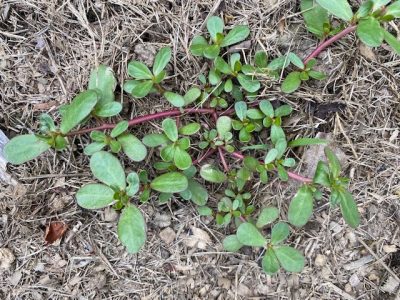
Low-growing plant with reddish stems and small, thick oval green leaves spreading across dry soil and mulch, resembling a common garden weed like purslane.
Purslane. Photo by Dawn Pettinelli

By now the vegetables and flower beds should be pretty well planted and plants starting to establish themselves. Despite many of our best efforts, a new crop of weeds is also attempting to get established. These garden pests compete for light, water and nutrients. They also may harbor or attract insects that prey on our plants. If left to their own devices, they can crowd out our desirable specimens reducing the air flow and leading to conditions more conducive to disease.

Weeds are generally sorted into 4 categories: perennial, biennial, winter annuals and summer annuals. There’s a good chance that you removed any winter annuals as you prepared your planting areas. These plants typically germinate in the fall, overwinter, bloom in early spring and set seed. They include weeds such as annual bluegrass, chickweed and shepherd’s purse.

Perennial weeds include dandelions, burdock, thistle and plantains while Queen Anne’s lace and garlic mustard are some biennial ones. Usually, the summer annual weeds are most prevalent in recently planted vegetable and flower beds. Some examples are lambsquarters, galinsoga, purslane, crabgrass and ragweed.

You have probably heard the expression ‘A year’s worth of seeding is worth 7 years weeding’ or something along that line. Weed seeds can last a long time in the soil with purslane and dandelion seeds remaining viable up to 20 years and pigweed up to 40 years. So even letting a few weed plants go to seed will have you pulling up their progeny for quite some time.

What’s a gardener to do? The key to weed control is to stay ahead of them. Take them out when they are small and shallow rooted. For areas that are pretty much bare soil, like around vegetable plants, a small handheld hoe or cobra head weeder works great on patches of newly germinated weeds that are too tiny to pull by hand. For larger gardens, maybe a taller blade or stirrup hoe would be a good tool to have on hand.

I will admit to spending a lot of time on my hands and knees weeding. While this may be not practical for everyone, it gives you a chance to get up close and personal with both the weeds as well as your garden plants so you can see, for example, if any squash vine borers are attacking your squash or pumpkins or if your radishes are ready to be harvested or if that row of bean seeds has yet to germinate.

Mulch can be a gardener’s best friend. The key is to match the mulch to the garden. For vegetable gardens, straw mulches, shredded leaves or untreated grass clippings work well as they degrade over the season adding organic matter to the soil and feeding the bacterial microbes that are most active and essential in agricultural type soils. While many people use plastic, weed fabric or cardboard to keep weeds down, these have been shown to have negative effects on soil health. The benefits may outweigh the costs for commercial growers but for the home gardener, healthy soils mean healthy plants. Plus carboard, especially corrugated pieces often contains contaminants.

For perennial flower beds, I like the look of cocoa shell (if you don’t have dogs that would eat them) or buckwheat hull mulches. They set off your perennial foliage and flowering plants at a better scale than larger bark mulches, nugget mulches or woodchips do. The problem with these being they are not always easy to find or cheap. For trees and shrubs, coarser wood or bark mulches would be appropriate. The bottom line for mulches, is that regardless of which one you chose, it will help to keep weeds down.

In certain situations, the use of an organically certified (OMRI) herbicide might be helpful. There are a number of products on the market that contain essential oils, like clove or citrus, sodium or ammonium derivatives or even acetic acid (vinegar). I find them handy for high populations of just germinating weed seeds before planting or in pathways between rows. The tiny weeds are killed quickly especially on a sunny day.

Two things to consider when purchasing these products are that they typically do not kill the roots of larger established weeds. The top will generally die back but the roots are still alive and will resprout. The other thing is these organic weedkillers are non-selective meaning they can kill any plant they are sprayed on.

However, you choose to remove them, persistence and regular scouting will keep weeds to a minimum. Because the seeds can be in the soil, be transported when purchasing compost or plants, can blow in from the neighbor’s garden or even be moved by animals and people, weeds will always find a way into your gardens and it’s your job to keep them out.

Have a question about plants? The UConn Home Garden Education Office supports UConn Extension’s mission by providing answers you can trust with research-based information and resources. For gardening questions, contact us toll-free at (877) 486-6271, visit our website at homegarden.cahnr.uconn.edu, or reach out to your local UConn Extension Center at extension.uconn.edu/locations.
 

This article was published in the Hartford Courant June 13, 2026

Dodder – A Common but Weird Parasitic Plant

By Pamm Cooper, UConn Home & Garden Education Center

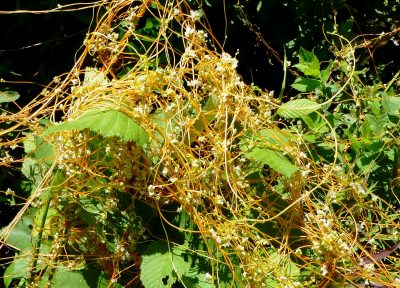
Dodder plant wrapped around a host and flowering
Photo by Pamm Cooper, UConn Home & Garden Education Center

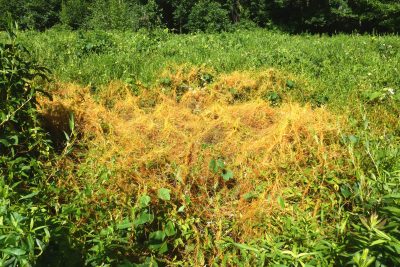
Dodder is an obligate parasite of certain plants. This unusual member of the morning glory family is also known as “Angel’s Hair” and “Strangle Weed.” Like Indian pipe, another parasitic plant, Dodder has no chlorophyll to manufacture its own food, so nutrients and water are obtained from its host plant.  Its yellow to orange twining stems can form stringy, dense orange mats that cover its host plants, and it will often climb over other nearby plants as well. This vine twines counterclockwise around stems and other parts of its host.  Look for it in mid- July through September in damp fields or on stream and pond banks. 

Dodder germinates from seeds produced in earlier years. The new plants have only a few days to find a suitable host plant, or they will die. After connecting with the host plant, dodder will degrade at the soil level where it originated and is then free of any soil contact. Dodder has no leaves or roots, but it does produce flowers and then seeds.  The only way new plants can be re-established is from seed produced at least the previous year or even earlier.  

Dodder feeds on its host by means of small tubes called haustoria that pierce into the hosts leaf or stem vascular system. One type will siphon water from the xylem, and another type will obtain food (minerals, sugars etc.) from the phloem of the host plant. In this way, dodder obtains essential nutrients and water for its own survival at the expense of its host plant. Five-angled dodder Cuscuta pentagona, a very common dodder species found here in Connecticut does not have specialized host plant preferences. 

Since not all plants are suitable hosts for dodder, and because it needs to find a host quickly, dodder has a unique ability to “sniff out” certain plant chemicals and will gravitate toward these plants soon after germination. Notable hosts are jewelweed in the wild and tomatoes in crop cultivation. Thus, if you are interested in finding dodder, in July and August check out places where jewelweed abounds. Look for mats of orange, stringy vines covering the tops of this plant and perhaps on nearby Joe-pye weed and goldenrods.  

Yellow strings of dodder encompassing plants in a field
Photo by Pamm Cooper, UConn Home & Garden Education Center

Dodder seeds can survive in soil for twenty years or more and will germinate as conditions are suitable. Because of the longevity of its seed viability, dodder may be found either yearly in the same area or appear there years later. Flooding can also relocate the seeds, so it may appear along various spots along the same stream or pond. Look for its small white flowers appearing in clusters along the vine in late July and August. 

Once dodder is firmly established on the host plant in the wild, research has shown that removal of the host plants and the dodder, especially before seeds are set on the dodder, will be more effective than other methods. This may need to be done yearly until any seed bank is exhausted. Try to scout early in July as dodder is getting established. Sometimes small dodder plants can be removed from the host. Some people with dodder persisting in extensive areas have burned these sites, and this will also severely impact any seeds on the ground. 

Dodder is an aggressive plant, but it is not considered invasive because it is a native plant. It has received the dubious honor of making the Federal List of Noxious Weeds, though.  Although its hosts may be severely weakened, dodder does not always kill its host. While that is not reasonable cause to let it run rampant in a garden, in the wild it is in more of a tournament for survival. May the best plant win… 

The UConn Home & Garden Education Center supports UConn Extension’s mission by providing answers you can trust with research-based information and resources. For gardening questions, contact us toll-free at (877) 486-6271, visit our website at homegarden.cahnr.uconn.edu, or reach out to your local UConn Extension center at cahnr.uconn.edu/extension/locations. 

This article was published in the Hartford Courant September 1, 2025

Weed Management for Late Summer

By Heather Zidack, UConn Home & Garden Education Center

With a perfect combination of warm days, cool nights, and plenty of rain, every gardener has been fighting weeds since this summer began! To add to the frustration, the weather patterns themselves have felt like they have fallen on weekends, holidays, and all those precious hours that we love to be spending in the garden, making it difficult to get out and manage what is there. So how do we catch up?  

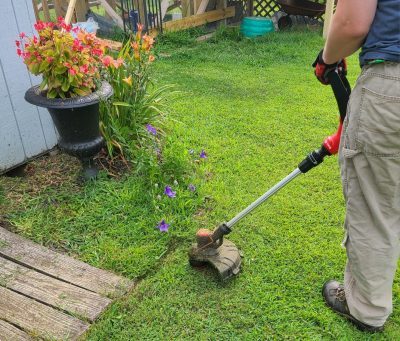
A person using a weed wacker
Photo by Heather Zidack, UConn Home & Garden Education Center

I’m sorry to say that the adage of “pick your battles” is going to be the best strategy to keep you from “getting lost in the weeds.” Mechanical removal like string trimming, mowing, or cultivating your garden are always effective. But some of us are looking for something that feels more efficient or saves our back from hours of labor-intensive weed pulling in this summer heat. Strategizing more long-term goals for your planting beds and lawns might be better for you than running outside with your garden weasel right now.  

We’ve all heard “nature abhors a vacuum” before. Weeds are no different. If turf is thin, or garden beds are left with uncovered soil, weeds will pop up. Utilize groundcovers and mulches to keep soil covered. If you’re in between plantings in the vegetable garden, a temporary cover, like cardboard, may keep seeds from contacting the soil until you’re ready to plant! For more long-term coverage, consider cover crops in your vegetable gardens.  

Encourage dense plantings through proper fertilizing, watering, and care. Healthy perennials and shrubs will shade out seeds that may try to germinate below them. For lawns, consider overseeding to bulk up thinned turf areas between August 15th and September 15th.  Mulch garden beds and pathways with a minimum depth of 3 inches if groundcovers aren’t being used.  

Once you have soil coverage under control, look at the nutrition. When the soil is not nutritionally supportive, you often find compounding issues like patches where you can never get grass to grow, poor vegetable production/flowering, and lots of weeds! Many weeds can thrive in these poor soils. While weeds aren’t necessarily a definitive indicator of a nutrient problem, it can be another clue when looking at the health of your planting areas. If you kill the weeds, and the soil remains poor you can expect weeds again the following season. Therefore, testing your soil and correcting imbalances is a long term and sustainable solution.  

Some common weeds, like crabgrass, are beyond a stage where we can easily control them with methods available to the homeowner. Fear not! Crabgrass is an annual, and the plants themselves will not return next year! They, instead, propagate through seeds.  

At this point in the season, shift your focus towards minimizing next year’s seed bank. As much as we loved to “make a wish” on a dandelion as children, we were only spreading more dandelions into the yard! Keep this in mind now as you tend your garden. Cut grass before weeds can develop flowers and distribute seeds. Remove plants like pokeweed, before they have a chance to develop berries that can be carried off by animals.  

Don’t underestimate the value of a good identification. Knowing the exact species of weed in the garden can help you make a targeted approach with whatever physical, cultural, or chemical method you might be considering.  

If you must resort to chemical management, read the label in full and follow all instructions provided. At the UConn Home & Garden Education Center we do not recommend the use of anecdotal home remedies for weeds. Many of these methods are not researched. Products used in the garden should be labeled for use on a specific host, a specific pest, and have specific application instructions. As an example, while vinegar may be recommended anecdotally to use on weeds in the garden, one should only consider a product like horticultural vinegar that has a specific formulation, concentration, and a product label that clearly identifies its uses, safety precautions, and instructions for use.  

No matter what weed you are trying to manage, persistence is key. This is especially important to remember if you’re dealing with the most aggressive weeds, or even invasive plant species. Rarely do we see a single treatment leading to complete eradication. So don’t be discouraged if plants are taking multiple seasons to tackle. The CT Invasive Plant Working Group has great guidances on what you should do for specific species of invasive plants like Japanese Knotweed, Mile-A-Minute Vine, Tree of Heaven, and more.  

If you have specific questions or need help with weed identification in the lawn or garden, send us pictures, or stop by with a sample.  

The UConn Home & Garden Education Center supports UConn Extension’s mission by providing answers you can trust with research-based information and resources. For gardening questions, contact us toll-free at (877) 486-6271, visit our website at homegarden.cahnr.uconn.edu, or reach out to your local UConn Extension center at cahnr.uconn.edu/extension/locations. 

This article was published in the Hartford Courant August 9, 2025