plant-care

A Spider Everyone Can Love

By Dr. Matthew Lisy, UConn Adjunct Faculty

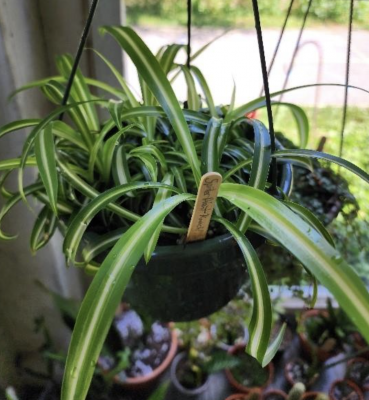
Hanging pot of a spider plant with long, arching green leaves striped with white, labeled with a small wooden plant marker.
Chlorophytum comosum, the Spider Plant (photo by M. Lisy).

 Spiders are one of those creatures that humans fear.  Most here in the Northeast are totally harmless, yet many times people run and occasionally hurt themselves trying to get away from them.  As such, it is interesting to me that one of our most beloved plants is called “Spider Plant.”  Its growth does superficially resemble a spider, but this one brings joy to its owners.  In fact, it is one of the hardiest of all our houseplants.   

Scientifically it is known as Chlorophytum comosum, and there is quite a bit of controversy in the scientific community over species.  In the pictures accompanying this article, the differences in the leaves can be clearly seen.  The great debate stems from (pun intended) differences in leaf shape.  Scientists cannot decide on whether those differences represent phenotypic variation (changes in shape found within a population) or differences between species.  And while it seems like this should be an easy task, look at all the differences seen in dogs, which are all the same species.  While the leaves on our houseplants most likely represent different artificially selected cultivars (varieties), determining how many there are in the wild is difficult.  Plants normally have some ability to change the shape of their leaves.  For example, plants grown in shade tend to have larger leaves than those grown in full sun.  These plants are native to South Africa, and tend to grown in forests, which could explain why such variation is seen in the wild.  There were two other species listed for a while, but then those got lumped back in to C. comosum and their differences chalked up to environmental variation.     

In reality, how many species there are does not really matter for us keeping these wonderful houseplants.  What does matter is their forgiving nature.  They grow and thrive in any typical houseplant soil.  It is best to let the surface dry before watering again.  They have an interesting root system that is part of the key to their success.  The thick, tuberous roots store water, and that is why they can survive for much longer than other houseplants.  When repotting, it is amazing how they fill the pot completely with roots.  Although it sounds like this might become a problem, the Spider Plant does not mind.  It responds with more leaves, and even babies. 
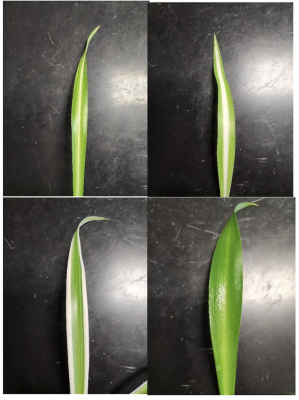
Four close-up views of a single variegated spider plant leaf on a dark surface, showing its green edges and white center stripe from different angles.
Spider Plant varieties, clockwise from the top left: a) from my first-grade teacher - narrow leaf with thin green stripe, b) wide leaf with wide white stripe, c) all green wide leaf, d) green leaf with white edges (photos by M. Lisy). 

The Spider Plant is easily propagated by planting the little plantlets that form along runners sent out by the mother plant.  Simply plant these in typical houseplant soil, water well, and they will start to grow.  As they do not have a fully developed root system yet, care must be taken to not let them dry out during the beginning stages.  This plant is probably the most easily propagated houseplant.  I still have one propagated by my first-grade teacher.  It grew in the classroom when I was there, and two years later when my sister had the same teacher, it had produced babies that were sent home with each student.  Despite all of life’s ups and downs, the plant is still going and thriving almost half a century later.

There are a number of interesting varieties of this plant.  The leaves can be narrow, wide, or curled.  The colors of the leaves are interesting as well, and can be found in any combination of leaf-types.  There are green leaves with a white center stripe.  Alternatively, there are green leaves with white edges.  As one would expect, there are all green leaves too.  Although I do not have one yet, there is a variety called ‘Hawaiian’ that has a green leaf with a yellow center.  Don’t be fooled by some so-called Spider Plants that are purple – those are actually Tradescantia, or Spiderworts, which are a totally different species of plant native to the Americas.  No matter which variety is chosen, with proper care Spider Plants could bring the owner enjoyment for a lifetime!  

The UConn Home Garden Education Office supports UConn Extension’s mission by providing answers you can trust with research-based information and resources. For gardening questions, contact us toll-free at (877) 486-6271, visit our website at homegarden.cahnr.uconn.edu, or reach out to your local UConn Extension Center at extension.uconn.edu/locations. 
This article was published in the Hartford Courant February 1, 2026

Yes, You Can Grow Orchids!

By Dawn Pettinelli, UConn Home and Garden Education Center

Some favorite booths at the CT Flower and Garden Show this past weekend were the ones filled with orchids. Orchids are becoming more popular as houseplants and many folks are finding that they can be grown successfully in the home without elaborate care or special equipment. If you’re in a traveling mind, check out the Orchid Exhibit at the New England Botanic Garden in Boylston, MA that runs through March 23, 2025.

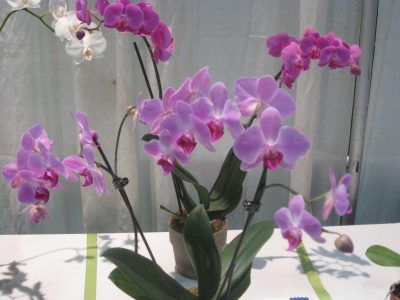
Purple orchids in flower
Phalenopsis orchids at the CT Flower & Garden Show in 2025. Photo by Dawn Pettinelli

Orchids are grouped into two general divisions. Epiphytic orchids naturally grow on trees in the tropics. Trees are used for support. Water and nutrients come from rain, bird droppings and organic debris collecting around the roots. Terrestrial types will grow in a highly organic soil. While epiphytic orchids may tolerate or even enjoy a dry, dormant period, terrestrial species, in general, need to be kept moist throughout the year.

Two styles of growth are exhibited by orchids. Monopodial orchids grow in an upright direction from the central stem on which aerial roots and flowers develop. Sympodial orchids generate new growth from the base of the plant. As the new stems mature and bloom, younger shoots once again are produced and the cycle is continued.

The orchid family is organized into several genera (each called a genus) which may contain from one to many species. Much hybridization has occurred and the names can be baffling to a novice. For instance, hybrids resulting as a cross between Cattleya mossiae and C. warscewiczii are labeled Cattleya x Enid, the ‘x’ indicating the plant is a hybrid.

Some of the easiest orchids for beginners are phalenopsis, paphiopedilum, epidendron, oncidium and cattleya. Not every member of each genera can be successfully grown in the home so be sure to check with your source. Almost all colors are available and blossom size may range from very tiny to several inches in diameter.

The basic requirements for orchids are good ventilation, 40 to 50 percent humidity, light, proper watering and a well-draining potting mix usually composed of fir bark. Often osmunda fiber, tree fern and/or perlite are added to the fir bark.

Specific cultural requirements vary as to the species. Some tolerate higher light levels than others. Many varieties of the orchids listed above prefer 55 to 60 degree F nights and 65 to 68 degree F days although cattlyas, epidendrons and oncidiums like it about 10 degrees warmer. If growing on a windowsill, put the varieties that like it cooler closer to the window. Make sure leaves do not touch the glass.

Ways to increase humidity include grouping plants together, placing on gravel lined trays filled with water, frequent misting or use of a humidifier. Plants should not sit in water and the foliage, if misted, should be dry by evening. Don’t keep plants too close together as good air circulation helps prevent diseases.

Watering is perhaps the trickiest part of growing orchids. There is not accurate rule for when to water because it depends on the size of the container, the type of growing medium, temperature and light conditions. Obviously, plants will have to be watered more often in hot, dry weather and less during cool, damp periods. When watering, soak the potting material thoroughly. Do not water again until the medium feels dry to the touch. If in doubt, do not water.

Since fir bark contains virtually no nutrients, plants have to be fertilized on a regular basis. Some recommend fertilizing at every third watering with a half strength orchid fertilizer. It is best to place plants in the sink and water until it drains from the pot, not putting the plant back in its saucer until it is thoroughly drained. Special orchid pots are available with enlarged drainage holes. Fertilizers should just be applied when plants are actively growing.

Orchids are a plant you have to experiment with but once you’ve experienced success, you will find that as a hobby, they can be quite contagious. Those seeking more orchid information might want to check out the Connecticut Orchid Society (www.ctorchids.org) or the American Orchid Society (www.aos.org).

If you have questions on growing orchids or any home or garden topic, contact the UConn Home and Garden Education Center, toll-free, at 877.486.6271 or visit us at www.homegarden.cahnr.uconn.edu or call your local Cooperative Extension Center.


This article was published in the Hartford Courant Mar. 1, 2025