Trees

Remove Those Suckers!

By Dawn Pettinelli, UConn Home & Garden Education Center

About now the gardens should be planted, and it is time to turn our attention to the trees and shrubs on the property. New growth is almost fully expanded and pruning of spring flowering shrubs can commence. When out there with your pruners, keep an eye peeled for suckers and water sprouts, both on the plants you’re pruning and other woody plants in the yard.
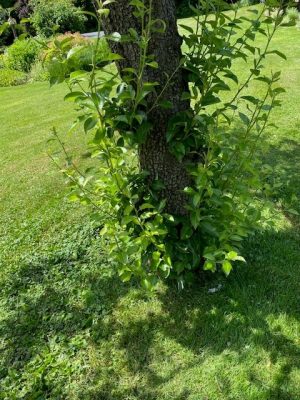
A pear tree with multiple suckers growing from the base. Photo by dmp2024

Many trees and shrubs produce vigorous, upright stems that can reach several feet high over the growing season if left unchecked. Those arising from the root system are known as suckers while those growths arising from the crown portion of a tree or large shrub are referred to as water sprouts. At the very least, they are unattractive and take away from the architectural framework of a plant. More importantly they use water, nutrients and energy that could be put to better use if not taken from the rest of the plant. If not removed, they can crowd out the main plant resulting in reduced vigor.

Some woody plants naturally tend to produce suckers and sometimes these young vigorous shoots are needed to rejuvenate older plants as aging stems are removed. An example would be shrubs like red-twigged dogwoods or lilacs. Suckers arising from trees such as apples, crabapples, honey locust, lindens and others, however, should be removed.

In the case of grafted plants, like hybrid tea roses or apples, the desired variety is grafted on to a rootstock that might be more cold hardy, have dwarfing genes or other desired features. Occasionally the rootstock revolts, so to speak, and sends up its own shoots. In the case of roses, one might notice a stem with red flowers when the plant was purchased as a named cultivar with different colored flowers.

Suckers and water sprouts often occur because plants are in some way stressed or due to damage to their root system. Plants can be under stress for a number of reasons. Some common reasons would be insect or disease problems, drought, too high of a water table, compacted soil and/or difficult growing conditions.

Planting too deep will also stress a plant and could cause suckers to develop. Whenever planting woody plants sink them so that the level of soil in the pot they are grown in is level with the soil they are planted in.

Another reason for suckers or water sprouts is that plants are pruned incorrectly or too drastically. Seldom is it advisable to remove more than one-third of the plant at one time. Also, avoid topping ornamental or woodland trees.

Ideally suckers and water sprouts should be removed as soon as they are produced. Often, they can just be rubbed or twisted off in spring as their stem is just starting to expand. Once they reach pencil-size in thickness, cut with clean, sharp pruners. Do your best to remove them flush to a limb or as close to the tree’s trunk or root system as you can. Don’t leave stubs as these will likely have buds at their base and just regrow.

Speaking of suckers, there are often questions when growing tomatoes about what to do with the sprouts popping up where the leaf attaches to the main stem. Typically suckers just form on indeterminate tomato varieties, which are those that continue to grow, bloom and set fruit as long as growing conditions allow.  If all suckers are left on the plant, it becomes quite unruly and hard to stake. Also, fruit will be plentiful but usually smaller.

Usually, the suckers below the first fruiting cluster are removed so the development of those tomatoes won’t be slowed. Then it is up to individual gardeners to decide whether to leave suckers or not and how many to leave. Often a few are left to increase and extend the harvest. Tomatoes in our area are prone to many leaf diseases, especially during humid and wet seasons. As the bottom leaves yellow and die, it is beneficial to let some of the suckers on top grow so plants can produce more foliage to yield food for the plant and to shade the developing fruit. Some experimentation might be necessary keeping in mind that it is better to remove too little than too much.

For questions about pruning suckers and water sprouts or on other gardening topics, feel free to contact us, toll-free, at the UConn Home & Garden Education Center at (877) 486-6271, visit our website at www.homegarden.cahnr.uconn.edu or contact your local Cooperative Extension Center.
Tips on Selecting a Flowering Tree

By Dawn Pettinelli, UConn Home & Garden Education Center

If there’s a spot for a spring flowering tree in your landscape, now is the time to look at the trees showing off their floral splendor. Do you find one or two particularly appealing. Take note of the various flower colors, tree shapes and sizes. Once you’ve selected an alluring flowering tree or two, do a bit of homework.

Many of the spring flowering trees have several cultivars and they may vary in flower color, leaf variegation, mature height and width, fall color and so on. Pick the one that fits your location. Will the plant be in sun or shade? Is it going to be positioned as a specimen tree or incorporated into a foundation planting or a border? Will it add multi-season interest with attractive foliage, fruits or seed pods, or interesting bark? What insect or disease problems is it prone to?

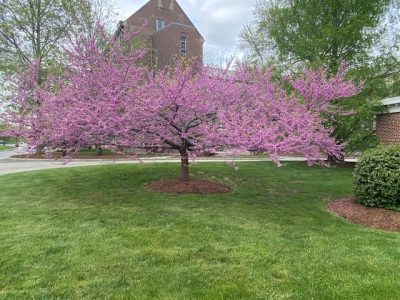
A redbud tree in flower on the UConn Campus
A redbud tree in flower on the UConn Campus. Photo by dmp2024

Redbuds (Cercis canadensis) are bursting with blossoms right now, at least on the Storrs campus. The extremely abundant, purple-pink peas shaped blossoms practically cover the tree. At maturity, trees reach about 20 to 30 feet tall with a slightly larger width, ending up in a roundish shape with a flatter top. After flowering, heart-shaped leaves develop while faded blossoms give birth to small, flattened legume seed pods that contrast nicely with the plant’s dark, scaly bark. Cultivars are available with white or more true pink flowers, variegated foliage, weeping forms and attractive fall foliage colors. Redbuds tolerate full to part sun and well-drained soil but avoid hot, dry locations for best establishment and flowering.

Dogwoods are a favorite of many. Their pink, white or red colored bracts dazzle especially in filtered sunlight. Dogwoods are native to the eastern and central United States where they are usually found as an understory tree. Most cultivars grow to about 30 feet in height with about the same width at maturity. The large 4-inch blossoms mature to form shiny red fruit much loved by birds. These exceptionally beautiful plants favor a cool, moist, acidic soil with adequate amounts of organic matter. Dogwoods struggle when faced with heat stress, drought, and pollutants so site carefully.

Another flowering tree that also does best in more natural settings, especially those with moist soils is our native shadbush or serviceberry (Amelancher canadensis). The name, shadbush, comes from the fact that this plant typically blooms when the shad return to fresh water to spawn, usually right about now. This plant can be grown as a single stemmed specimen or a multi-stemmed large shrub. Mature trees reach about 20 feet in height but there are shorter, more shrub-like cultivars. Shadbush sports white flowers in 2-to-3-inch racemes. Dark fruits are attractive to many animals plus both the gold autumn foliage and gray bark are very attractive.

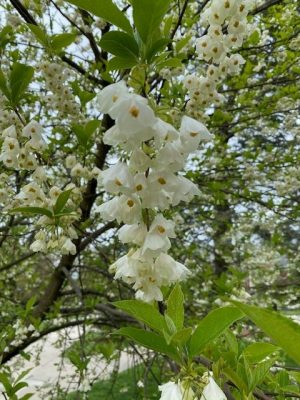
Carolina silverbells in flower.
Carolina silverbells in flower. Photo by dmp2024

A standout for me this time of year is Carolina silverbells (Halesia carolina). A multitude of white, bell-shaped blooms adorn the branches of this 20-to-40-foot tree. Although it is native to southeast U.S., it is hardy to zone 5. Autumn color is not notable, but the tan 4-winged fruit persist well into the winter and stand out against the stark winter landscape and silvery grey bark. Be sure to check out ‘UConn Wedding Bells’, a very floriferous cultivar discovered by UConn Plant Science professor, Dr. Mark Brand. It has a smaller, rounder form with flowers larger than the species.

The star magnolia (M. stellata), as its Latin name implies, is definitely a stellar landscape plant. Gorgeous, lightly fragrant 3-to-4-inch blossoms grace the dense cluster of stems. Mature plants reach up to about 20 feet with a slightly narrower width. Plants do produce red fruits but most drop before they mature. I was delighted to find a seedling after I lost the parent tree in that late October snowstorm we had a number of years ago.

Other worthy spring flowering trees to consider include the flowering crabapples and cherries that have many exciting and lovely cultivars. A great place for information on woody plants is the UConn Plant Database (www.plantdatabase.uconn.edu). If you need more information on selecting a tree or any plant for your landscape or on other gardening topics, feel free to contact us, toll-free, at the UConn Home & Garden Education Center at (877) 486-6271, visit our website at www.homegarden.cahnr.uconn.edu or contact your local Cooperative Extension center.


Eastern Tent Caterpillars

By Pamm Cooper, UConn Home & Garden Education Center

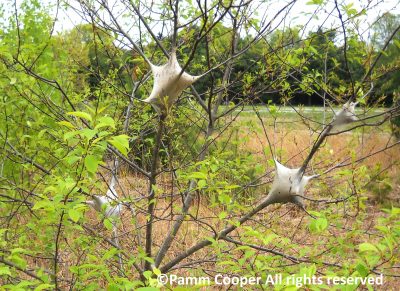
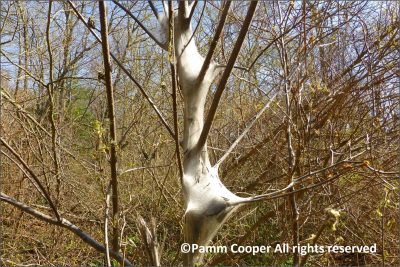
Eastern Tent Caterpillar Tents in a tree

Eastern tent caterpillars, Malacosoma Americanum, are native to North America and are noticed mainly because of the silken tents they build in the forks and crotches of trees in early spring. While most tents are found on black cherries, they can also be found on other trees such as apple and crabapple. They are readily visible since tents are constructed before leaves fully expand. There is only one generation per year.

These caterpillars are hairy and dark when small, and later instars have two yellow lines along the back. A white medial stripe goes along the sides of the body, and this is flanked by two yellow lines. There are blue blotches along its side as well. Bottom hairs on the body are rusty brown. Forest tent caterpillars are also hairy, but they do not make tents, and their bodies

are blue with white dots on the back. Handling should be done with gloves on as some people may have sensitivity to the hairs.

Egg masses are black, laid on small branches of host trees the previous year, and the egg mass rings around the branch. Sometimes they are mistaken for small black knot galls. 150-300 eggs may be in each egg mass. Caterpillars typically hatch as black cherry leaves begin to expand the next spring. Caterpillars feed on leaves and buds and rest communally by day in the nests they construct from silk.

While they can almost defoliate small trees, these caterpillars usually have completed their feeding stage in time for the trees to put out new leaves by early summer. The more tents there are on small trees, though, the greater number of caterpillars there are, so damage will increase.

While protected from many predators while inside the tents, there are birds that will tear the tents apart to feed on the caterpillars inside. Both the black-billed and the yellow-billed cuckoos are known for their ability to do this, and native vireos will also seek out and rip apart the tents.

Mature caterpillars leave the host plants in early summer in search of suitable sites to pupate within a silken cocoon they will spin. Moths emerge later that year. The moths have a fluffy light brown body, and the wings have three bands with the center being narrower than the outer bands and a lighter brown in color. The center band is bordered on both sides by thin, creamy bands.

Eastern Tent Caterpillar Tents in a tree

Occasionally, eastern tent caterpillars have outbreak years where large numbers of the tents can be seen on the same tree. Fresh buds may also be consumed if trees are severely defoliated. When found on residential properties, tents can be swept apart by rakes or brooms, exposing caterpillars to predators, or knocking them off the trees. If warranted, foliage can be sprayed with a biological product called Bacillis thuringiensis subspecies, Kurstaki, or BtK, which only harms caterpillars and not other insects. Caterpillars will ingest the product as they feed on the foliage.

Most healthy trees can tolerate severe defoliation from eastern tent caterpillars. If concerned, look for egg masses in the winter on trees that had been damaged the previous spring. Remove them, if possible, or crush them, or prune the branch off below where the egg mass is found. Or let them be if the trees appear to have recovered. Letting nature take its course with native insects on native trees can often benefit birds and other predators. Do not confuse them with the notorious gypsy moth caterpillars which do not make silken tents or nests of any kind.

If you have a question about tent caterpillars or other gardening topics, contact the UConn Home & Garden Education at (877) 486-6271 or www.homegarden.cahnr,uconn.edu or your local Cooperative Extension Center.


Prune Now for Beautiful Summer Trees

Prune Now for Beautiful Summer Trees
By Marie Woodward, UConn Home & Garden Education Center

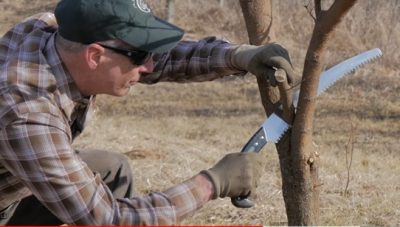
Person cutting a tree with a hand saw
Photo by arborday.org

Winter is a great time for gardeners to plan for their next growing season. Many think that planning can only be done inside. Not so. Now is an ideal time to prune deciduous landscape trees. The absence of leaves gives a clear view of the canopy above and allows for a clear assessment of a tree’s structure and any problems that may be present. In addition, there are no pests present in winter, and disease spread will be slowed by the cold weather. But before heading outside with those loppers and pruning saws, there are a few important things to know and consider.

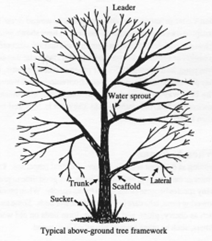
It's important to understand the tree’s anatomy. A typical deciduous landscape tree will consist of three main parts: the leader, the scaffolding branches and the lateral branches. The leader is the dominant vertical branch of the tree. This is easily spotted as the straight, most upward growth from the trunk. The leader is the tree’s most important branch, crucial for the tree’ structure, photosynthesis, and even distribution of nutrients. Scaffolding branches emerge from the trunk and the leader to make up the canopy of the tree. Secondary branches that grow from the scaffold branches are called lateral branches. Once you understand the basic structure of the tree, it’s much easier to successfully prune it.

Tree Anatomy

Photo from Virginia Cooperative ExtensionFirst, assess the tree. What species of tree is it? That will reveal its natural structure, something your pruning should ideally strive to support. Note though, that proximity to buildings or human activity nearby is likely to influence your pruning strategy (keeping scaffolding branches clear of buildings, for example, or making sure people can walk under the lowest branch?)

Locate the leader of the tree and look for problem branches. Dead, diseased, damaged, or crossing branches should be pruned first. When pruning dead or diseased branches, make cuts into healthy wood, well below the affected area. It’s also a good idea to disinfect tools between cuts to help prevent the spread of disease. (A 10% solution of bleach to water works well.)

After the tree’s diseased, damaged, or crossing branches are pruned, look for lateral branches that are trying to compete vertically with the leader. They can draw energy away from the leader and sap the tree’s vigor. Usually, there is no need to remove all of a competing branch. Just pruning the vertical portion back to the scaffold branch should be sufficient. This will slow the competitor branch’s rate of growth, allowing the leader to dominate.

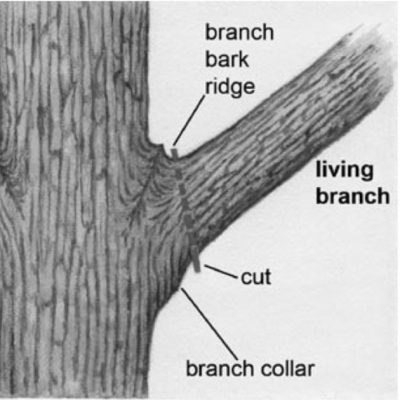
When pruning a scaffold branch, it is important to cut outside the branch collar. That is the swollen area at the base of the branch, where it joins the trunk.  Make the cut outside the branch collar at a 45-to-60-degree angle to the trunk and leave it alone to heal naturally. There is no need to coat or cover cuts. Doing so could prevent the wound from healing and might seal in pathogens adversely affecting the health of the tree.

Branch anatomy for cutting and pruning safely
Image from arborday.org

According to Pete Smith, forester and arborist from the Arbor Day Foundation, there are five main factors to consider when pruning trees:

  1. After pruning, two-thirds of the height of the tree should still have branches and leaves to keep growing in a healthy manner.
  2. Do not remove more than one third of the total branches in one year.
  3. Branches attached to the trunk should not be more than one half of the diameter of the main trunk.
  4. Every pruning cut should be no more than one inch in diameter
  5. There should be a total of five cuts in a year.

Of course, when pruning a long-neglected tree, it may take a few seasons to be able to apply all five rules, but ultimately, your trees will be healthier and more beautiful if you follow these guidelines.

For questions about pruning or if you have any other gardening questions, contact the UConn Home & Garden Education at (877) 486-6271 or http://www.homegarden.cahnr.uconn.edu/ or your local Cooperative Extension Center.