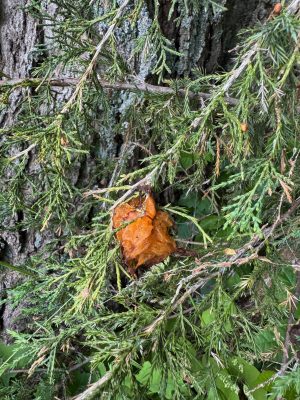
We all know that old saying, “April showers bring May fungi!” (No? Just me?). All joking aside, you may have noticed that the recent wet spring weather lead many fungi to break dormancy, release spores, and wind up in new places. While growers and gardeners often find themselves preparing for the season by promoting airflow between plants, increasing soil drainage, and applying preventive fungicides when really needed, it’s hard to deny the spectacle of spring fungi and the beauty they bring to our spring gardens; and few are as spectacular as cedar rusts (Again, only me?)!
Cedar rusts are flashy diseases caused by multiple species of the fungi in the genus Gymnosporangium. In the case of cedar apple rust, a disease we see all the time here in Connecticut, the causal agent is the fungus Gymnosporangium juniper-virginianae. Gymnosporangium is a group of heteroecious fungi, meaning that they require two hosts to complete their life cycles. Species within the Juniperus genus are primary hosts of cedar rusts with plants such as apple, crabapple, hawthorn, or quince usually serving as a secondary host, though close relatives such as pear or chokeberry may occasionally be seen with cedar rust.
Spores – small reproductive structures produced by fungi – are released from fungal structures to infect other hosts. Cedar rusts, attention seekers that they are, utilize multiple types of spores to get to their host plants of choice. Beginning with the secondary hosts in late summer, spores called aeciospores are produced and distributed by wind and rain, traveling to inoculate nearby juniper trees. Wet, mild weather in early fall creates the perfect conditions for these aeciospores to germinate, eventually resulting in the formation of large galls on the primary host.
Juniper galls are irregularly shaped structures on the plant and range in color from gray to dark red. Circular indentations are present on the gall’s surface, through which bizarre looking telial horns protrude in the spring the year after the host is first inoculated with the disease. These structures are first colored dark brown and have a dry appearance but later become gelatinous and bright orange as they mature and expand for a brief time during moist spring conditions. The surfaces of telial horns are coated in teliospores which later germinate to form the next important player in the cedar apple rust disease cycle, basidiospores. After releasing spores, the telial horns will dry up and fall off. The basidiospores are then distributed by wind and rain to inoculate secondary hosts such as apples or crabapples. Immature leaves with wet surfaces are the most susceptible targets for infection.
The next stage of the disease cycle kicks off with yellow-orange lesions that appear on the upper surfaces of leaves. A halo of red tissue may surround the edges of these spots, giving a dramatic bullseye appearance. Tiny, raised, fungal structures known as pycnia develop within the leaf lesions and on fruit surfaces. Pycnia produce pycniospores (notice a theme here?), which leads to the development of aecia during mid-summer. Yellow or brown lesions appear on the underside of leaves, from which the tubular aecia and of course, their aeciospore-covered surface, protrudes. During late summer under dry environmental conditions, aeciospores are released and travel to nearby juniper hosts where the disease cycle begins again.
You might be thinking, “enough with the spore-talk! What should I do about cedar rusts if I see signs of them?” Rest easy - although cedar rust fungi are complex and dramatic, they typically don’t cause lasting harm, and there are plenty of management strategies available to mitigate their damage. Pruning can be used to promote airflow and eliminate galls from junipers before telial horns have an opportunity to develop, and appropriate fungicides may be applied to secondary hosts as a preventative measure. And for those thinking of purchasing a new tree, know that many apple and crabapple cultivars are available at the nursery with various levels of resistance to cedar rust.
Have a question about plants? The UConn Home Garden Education Office supports UConn Extension’s mission by providing answers you can trust with research-based information and resources. For gardening questions, contact us toll-free at (877) 486-6271, visit our website at homegarden.cahnr.uconn.edu, or reach out to your local UConn Extension Center at extension.uconn.edu/locations.