Plant Disease

Wet and Wild: the Complex Lives of Cedar Rust Fungi

By Emily Leahy and Dr. Nick Goltz, UConn Home Garden Education Office 

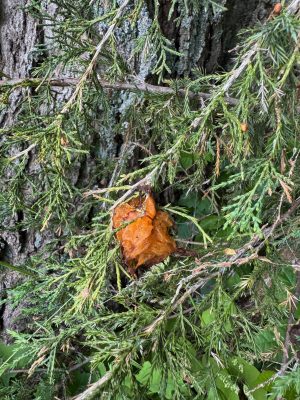
Orange, gelatinous cedar apple rust gall attached to a green cedar or juniper branch, with scaly bark visible in the background.
The telial horns observed on this Eastern Red Cedar (Juniperus virginiana) are beginning to dry up, but their gelatinous form and bold orange color are unmistakable.

We all know that old saying, “April showers bring May fungi!” (No? Just me?). All joking aside, you may have noticed that the recent wet spring weather lead many fungi to break dormancy, release spores, and wind up in new places. While growers and gardeners often find themselves preparing for the season by promoting airflow between plants, increasing soil drainage, and applying preventive fungicides when really needed, it’s hard to deny the spectacle of spring fungi and the beauty they bring to our spring gardens; and few are as spectacular as cedar rusts (Again, only me?)! 

Cedar rusts are flashy diseases caused by multiple species of the fungi in the genus Gymnosporangium. In the case of cedar apple rust, a disease we see all the time here in Connecticut, the causal agent is the fungus Gymnosporangium juniper-virginianaeGymnosporangium is a group of heteroecious fungi, meaning that they require two hosts to complete their life cycles. Species within the Juniperus genus are primary hosts of cedar rusts with plants such as apple, crabapple, hawthorn, or quince usually serving as a secondary host, though close relatives such as pear or chokeberry may occasionally be seen with cedar rust.  

Spores – small reproductive structures produced by fungi – are released from fungal structures to infect other hosts. Cedar rusts, attention seekers that they are, utilize multiple types of spores to get to their host plants of choice. Beginning with the secondary hosts in late summer, spores called aeciospores are produced and distributed by wind and rain, traveling to inoculate nearby juniper trees. Wet, mild weather in early fall creates the perfect conditions for these aeciospores to germinate, eventually resulting in the formation of large galls on the primary host.  

Juniper galls are irregularly shaped structures on the plant and range in color from gray to dark red. Circular indentations are present on the gall’s surface, through which bizarre looking telial horns protrude in the spring the year after the host is first inoculated with the disease. These structures are first colored dark brown and have a dry appearance but later become gelatinous and bright orange as they mature and expand for a brief time during moist spring conditions. The surfaces of telial horns are coated in teliospores which later germinate to form the next important player in the cedar apple rust disease cycle, basidiospores. After releasing spores, the telial horns will dry up and fall off. The basidiospores are then distributed by wind and rain to inoculate secondary hosts such as apples or crabapples. Immature leaves with wet surfaces are the most susceptible targets for infection.  

The next stage of the disease cycle kicks off with yellow-orange lesions that appear on the upper surfaces of leaves. A halo of red tissue may surround the edges of these spots, giving a dramatic bullseye appearance. Tiny, raised, fungal structures known as pycnia develop within the leaf lesions and on fruit surfaces. Pycnia produce pycniospores (notice a theme here?), which leads to the development of aecia during mid-summer. Yellow or brown lesions appear on the underside of leaves, from which the tubular aecia and of course, their aeciospore-covered surface, protrudes. During late summer under dry environmental conditions, aeciospores are released and travel to nearby juniper hosts where the disease cycle begins again.  

You might be thinking, “enough with the spore-talk! What should I do about cedar rusts if I see signs of them?” Rest easy - although cedar rust fungi are complex and dramatic, they typically don’t cause lasting harm, and there are plenty of management strategies available to mitigate their damage. Pruning can be used to promote airflow and eliminate galls from junipers before telial horns have an opportunity to develop, and appropriate fungicides may be applied to secondary hosts as a preventative measure. And for those thinking of purchasing a new tree, know that many apple and crabapple cultivars are available at the nursery with various levels of resistance to cedar rust.  

Have a question about plants? The UConn Home Garden Education Office supports UConn Extension’s mission by providing answers you can trust with research-based information and resources. For gardening questions, contact us toll-free at (877) 486-6271, visit our website at homegarden.cahnr.uconn.edu, or reach out to your local UConn Extension Center at extension.uconn.edu/locations. 
This article was published in the Hartford Courant May 30, 2026

The Challenges of Boxwood: Pests, Diseases, and Alternatives

By Marie Woodward, UConn Home & Garden Education Center

Boxwood, a classic choice for formal gardens and hedges, has faced increasing threats in recent years. As gardeners grapple with these challenges, it is crucial to understand the issues at hand and explore alternative plants for our landscapes.

Boxwood Blight is an aggressive fungal disease that affects various Boxwood species and causes rapid defoliation and potential plant death. First identified in the United Kingdom in the mid-1990s, this disease has since spread across North America. Early symptoms include stem cankers, sunken lesions, and eventual dieback. To mitigate the risk of Boxwood Blight, choose resistant cultivars, practice good garden hygiene, and monitor your plants for early signs of infection.

The Box Tree Moth is an invasive pest native to Asia that feeds on Boxwood plants. Since its arrival in North America, this moth has wreaked havoc on Boxwood populations, leading to defoliation and plant stress. Symptoms of infestation include see-through plants, "stick shrubs," and stem cankers. Regular monitoring and integrated pest management strategies are essential for controlling this destructive insect.

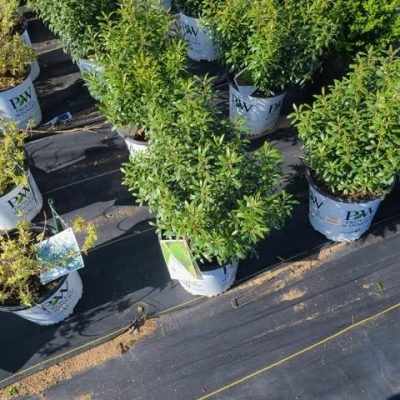
As Boxwood plants continue to face challenges from pests and diseases, it is wise to consider alternative options for our gardens. Ilex crenata (Japanese Holly) is a versatile, broadleaf evergreen that can be shaped into hedges or topiaries. Its small, glossy leaves provide a neat appearance, and its adaptability to various soil types and sun exposure makes it a low-maintenance choice.

Row of Gem Box Ilex shrubs for sale
Gem Box Ilex is one of many fantastic substitutes for Boxwood shrubs. Photo by H. Zidack

Euonymus japonicus (Japanese Euonymus), an evergreen shrub with small, glossy leaves and tolerance for a range of growing conditions is another possible substitution. Its compact growth habit and easy maintenance make it an excellent choice for hedges or screens.

Ilex glabra (Inkberry), is a slow-growing evergreen native to North America, featuring dark green leaves and red berries in the fall. Its low, spreading habit makes it ideal for low hedges or mass plantings.

Privets (Ligustrum), are fast-growing, low-maintenance evergreen shrubs with small, glossy leaves. They can be used for hedges, screens, or as stand-alone specimens. However, keep in mind that three cultivars, border privet, (Ligustrum obtusifolium Sieb. & Zucc), California privet, (Ligustrum ovalifolium Hassk.) and European privet (Ligustrum vulgare L.) are listed on UConn’s invasive plant databaseIf you decide to plant privets, look for seedless cultivars such as Golden Ticket privet (Ligustrum x vicaryi "KCLX1") at your local nursery.  

The Boxwood Blight and Box Tree Moth present ongoing challenges for gardeners and landscapers. By understanding these threats and adopting appropriate management strategies, we can mitigate the damage they cause. Additionally, exploring alternative plants can help create more resilient and sustainable gardens in the face of these challenges. With careful planning and thoughtful plant selection, our landscapes can continue to thrive in the face of adversity.

The UConn Home & Garden Education Center supports UConn Extension’s mission by providing answers you can trust with research-based information and resources. For questions about your boxwoods or other gardening questions, contact us toll-free at (877) 486-6271, visit our website at homegarden.cahnr.uconn.edu, or reach out to your local UConn Extension center at cahnr.uconn.edu/extension/locations.

This article was published in the Hartford Courant Feb. 22, 2025
It was been updated from its original publishing on Feb. 27, 2025

Watch for Bulb Diseases

Dr. Nick Goltz, UConn Home & Garden Education Center; UConn Plant Diagnostic Lab

Gardens in New England come to life in spring thanks, in large part, to bulbs! Spring bulbs are reliable, perennial color-bringers and seem equally at home in landscapes and containers. Daffodils (Narcissus spp.), grape hyacinth (Muscari spp.), and tulips (Tulipa spp.), are just some of the bulb plants that grace our gardens this time of year, and they remind us that the blooms of summer alliums aren’t far behind. While these plants might seem effortless to grow, they are not without their fair share of disease issues!

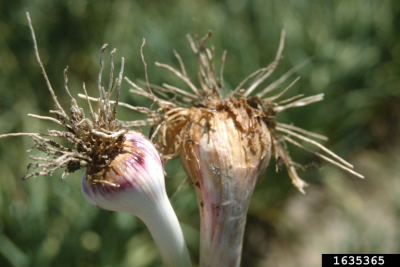
Purple streaking and weak root systems associated with Fusarium rot.
Purple streaking and weak root systems are symptoms associated with Fusarium rot. Ed Kurtz, budwood.org

One common disease of bulbs we see here in Connecticut is Fusarium wilt and bulb rot.

Bulbs generally prefer average to loamy soil with good drainage. When planted in clay soils or following long periods of rain in early spring, however, they are susceptible to rot diseases caused by fungal pathogens such as those in the genus Fusarium. The various wilt and rot diseases caused by Fusarium species can be destructive and sometimes difficult to control. Symptoms include wilting, brown lesions at and below the soil line, vascular discoloration, bulbs that are soft or spongey, and, especially with garlic (Allium sativum) and relatives, a purple-red discoloration of bulb tissue. Plants affected by this soil-borne fungal disease do not recover, so it is wise to be proactive with management and prevention.

If your bulb plants do not emerge properly in the spring or emerge but wilt soon after, fail to flower, or display other symptoms associated with root rot diseases, pull them up and throw them away! Fusarium and similar fungal pathogens often survive the winter in the soil on diseased plant tissue from the year before, so it is important to keep your garden clean and to not compost diseased plant tissue, as most home compost bins do not reach temperatures necessary to kill pathogens. Fungi like Fusarium thrive in soggy soils, so do your best to prevent flooding and standing water where bulbs are planted. There are no fungicides that will completely control or eradicate Fusarium in a landscape, but some are helpful with preventing infection of healthy plants. Remember to always wear protective equipment and follow label rates and instructions if you choose to apply fungicides.

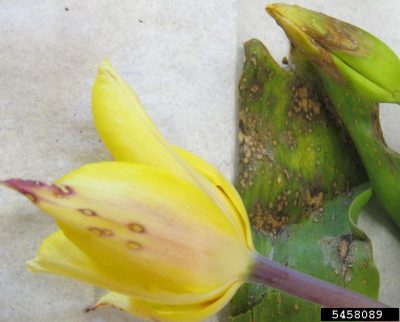
Symptoms of tulip fire, Botrytis tulipae, on tulip flower and leaves.
Symptoms of tulip fire, Botrytis tulipae, include leaf spots on leaves and flowers, often with dark boarders resembling burn injury, lending the common name. Sandra Jensen, Cornell University, Bugwood.org

Another common fungal disease of bulbs grown here in the Northeast is Botrytis gray mold or tulip fire. Fungi in the genus Botrytis cause disease symptoms on many different host plants. Though it is often called “gray mold” when associated with other plants, for tulips, the disease is usually called “tulip fire” due to the spots it causes on leaves and flowers, often with dark borders resembling a burn.

Botrytis fungi are very common and are capable saprophytes, meaning they feed on dead or decaying tissue and contribute to nutrient cycling in the environment, but can be problematic in managed landscapes. To cause disease, Botrytis fungi must first colonize and get nutrients from dead or declining plant tissue, such as fading flower petals, over-ripened fruit. Once the fungus is established in its host plant, it becomes more aggressive and invades healthy plant parts, causing brown lesions and decay.

To prevent Botrytis gray mold and tulip fire, try to encourage good airflow around your plants. Many people plant their bulbs closely together, like eggs in a carton, but this can make bulbs susceptible to tulip fire over time when treated as perennials. Dig up your tulips when they appear crowded, and each year when dealing with a potential disease issue. Inspect bulbs before you plant them again, and discard bulbs that are not firm, discolored, or otherwise do not appear healthy. Rotate to new locations and avoid planting consecutively in the same spot if there has been a history of disease there.

If you have questions about growing bulb plants, are dealing with a plant health issue, or regarding other gardening topics, feel free to contact us, toll-free, at the UConn Home & Garden Education Center by emailing ladybug@uconn.edu. You can also call us at (877) 486-6271, visit our website at www.homegarden.cahnr.uconn.edu, or contact your local Cooperative Extension center.