Solitary wasps are primarily hunting wasps which are either digger wasps or thread-waisted wasps. Most are seldom aggressive toward people because they are not defending a social colony. Instead, females are busy hunting other insects or arthropods to stock cells for a single larva to feed upon as they develop. Many solitary wasps dig nesting chambers in sandy soils, like the cicada killer and the great golden digger wasps. Others may use hollow pipes, tubes, window ledges or even sliding door tracks (a favorite site for the grass-carrying wasp).
Many of these wasps are also considered decent pollinators. They are active from June through late summer. The adult wasps die during the year and larvae generally pupate and emerge the following year. Females hunt specific prey such as caterpillars, katydids, cicadas and other insects which they paralyze and stock the nesting chamber with. An egg is laid on or near these future meals, and the larva will feed on them as it develops.
The great golden digger wasp, Sphex icheneumoneus, is a large wasp that sports golden hairs on the head and thorax and has a distinctive half orange half black abdomen. It is harmless to people and is often found on flowers in or near sandy soils where it digs nests for larvae in the ground. Main prey for larvae is katydids.
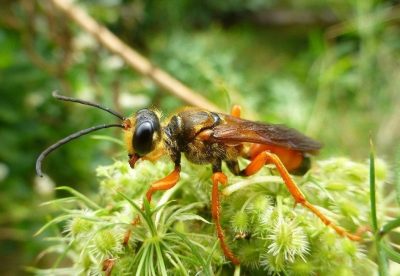
The Eastern Cicada killer, Sphecius speciosus, is one of the largest wasps in North America. It has amber wings and females are most evident in late July and early August as they burrow into sandy soils, leaving behind a squared off entrance and a sandy mound. Deep inside underground, the females have dragged paralyzed cicadas upon which they lay an egg. The larva will hatch and eat the paralyzed cicada. Next summer, after having pupated underground, the adults emerge. The females rarely sting but do alarm many homeowners due to their size and activity in lawns and along sidewalks.
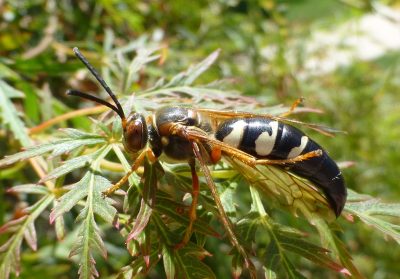
Grass carrying wasps Isodontia spp. create cells from grasses collected by the female. Each cell is stocked with paralyzed tree crickets, katydids and other orthoptera insects. Often packed together, these nesting cells can be found on windowsills, on bases of slider doors and on upper window ledges. Larvae overwinter in these cells and emerge as adults the following year or later that same year if there are two generations.
The oak apple gall wasp Amphibolips spp female lays an egg inside the tissue of an oak leaf inside which the larvae will hatch. The apple-like gall forms as a response to secretions from the larvae as it feeds on the leaf tissue safely inside. The gall turns brown after the adult wasp emerges. No damage is done to the oak. Cutting open the gall when green will reveal the wasp larva in the center.
Potter Wasp, Eumenes fraternus, females construct a small, rounded clay structure with a neck-like protuberance with a flattened top that makes it look like a tiny pot. After laying a single egg inside the female puts some paralyzed caterpillars and beetle larvae which the larva will eat. She seals the small opening with mud, which will be chewed open when the adult emerges next year. These tiny pots can be found on plants, rocks, pieces of wood and other places.
Solitary wasps pose little risk to us as they go about completing their life’s work. Defending nests is not a behavior such as is done by social wasps and hornets. Females will sting if handled or alarmed though, so avoid doing that. If digger wasps make you nervous, consider amending sandy soil with organic matter and keeping it moist when females are looking to excavate nesting chambers. Try to tolerate them for the short period of time they are active. Almost all can be found obtaining nectar from flowers in the wild and in cultivated landscapes.
The UConn Home Garden Education Office supports UConn Extension’s mission by providing answers you can trust with research-based information and resources. For gardening questions, contact us toll-free at (877) 486-6271, visit our website at homegarden.cahnr.uconn.edu, or reach out to your local UConn Extension Center at extension.uconn.edu/locations.