Nature

Tree Burls

By: Pamm Cooper, UConn Home Garden Education Office 

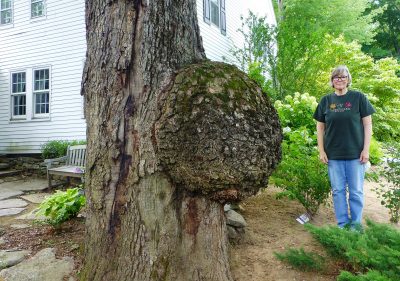
Large burl protruding from the trunk of an old sugar maple tree in a landscaped yard beside a white house. A person stands nearby for scale, highlighting the burl’s unusually large size and rough, moss-covered bark.
Photo by Pamm Cooper

Burls are sound, hard, woody swellings or protrusions that form on the trunks, branches, or roots of trees. They often appear as rounded or ridged masses with normal bark tissue. Burls are benign and are the result of a response in growth to outside stresses. The normal bark texture of the tree will be on the exterior surface of the burl. 

The exact cause of burl formation is a mystery, but these growths are formed by abnormal cell proliferation by the xylem. This growth can be triggered by stress factors such as environmental injury, insect feeding damage, or infections from fungal or bacterial pathogens. Some are thought to be the result of genetic factors that trigger abnormal growth without outside influences. Most burls are not causes of concern to the health of otherwise normally growing trees. Removal of burls from trees is not recommended as it will cause more harm than if the burl remains on the tree.  

Some tree species seem to have more burls than others. In our area oaks, maples, willows, cherry and elms have more of a tendency to form burls than other tree species. Sometimes small groups of the same tree species in a tight area may all have burls. Whether the cause is environmental, genetic or both would require a good amount of research. Even then, the root cause may be impossible to discover. 

Recently, a friend showed me a tree with one of the largest burls I have seen. This tree was located about a mile into the woods and was a good distance from the trail, but easily visible. It was almost five feet high and went almost completely around the trunk of the mature tree it was growing on. 

Because of the nature of unique formation and structure of burls, grain formation is unusual, creating swirling patterns that can be very beautiful. A bird’s eye pattern is the result of an aborted adventitious bud. This makes wood galls a highly prized find by woodworkers, who use the wood especially for veneers and bowls.   

There are woody galls caused by gall- forming mites, wasps or by fungal pathogens that are sometimes mistaken for burls. These include the black knot galls that form on infected black cherry and other Prunus species and are caused by a fungal pathogen, as well as horned galls on oaks that result from feeding by gall wasps. These types of growths can be harmful to the host tree.  

To tell if an abnormal growth on a tree is a burl or a gall, compare the outer surface and texture of the growth. Burls have smooth, rounded surfaces that are fully covered in bark. The tissue is solid wood and will have intricate, swirling grain patterns.  Galls typically have a rough texture to their surface, somewhat tumor-like and with vertical or horizontal ridges. The interior is not solid wood, but instead may be papery, pulpy or otherwise somewhat softer than the wood and is usually discolored. If cut open, there may be a wasp larva or a mite inside the gall. While both a gall and a burl result from excessive cell division, the causes are very different. 

If you want to learn more, a good article on tree burls can be found on this link from the University of New Hampshire written by forestry field specialist Greg Jordan.

The UConn Home Garden EducationOfficesupports UConn Extension’s mission by providing answers you can trust with research-based information and resources. For gardening questions, contact us toll-free at (877) 486-6271, visit our website athomegarden.cahnr.uconn.edu, or reach out to your local UConn Extensioncenteratextension.uconn.edu/locations.   

This article was published in the Hartford Courant July 25, 2026

Solitary Wasps Found in the Landscape and Garden

By Pamm Cooper, UConn Home Garden Education Office 

Solitary wasps are primarily hunting wasps which are either digger wasps or thread-waisted wasps. Most are seldom aggressive toward people because they are not defending a social colony. Instead, females are busy hunting other insects or arthropods to stock cells for a single larva to feed upon as they develop. Many solitary wasps dig nesting chambers in sandy soils, like the cicada killer and the great golden digger wasps. Others may use hollow pipes, tubes, window ledges or even sliding door tracks (a favorite site for the grass-carrying wasp). 

Many of these wasps are also considered decent pollinators. They are active from June through late summer. The adult wasps die during the year and larvae generally pupate and emerge the following year. Females hunt specific prey such as caterpillars, katydids, cicadas and other insects which they paralyze and stock the nesting chamber with. An egg is laid on or near these future meals, and the larva will feed on them as it develops.  

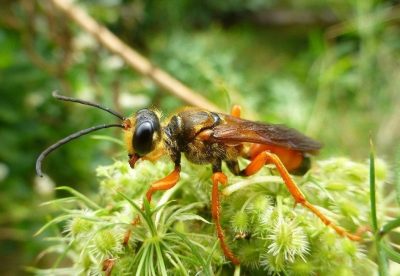
The great golden digger wasp, Sphex icheneumoneus, is a  large wasp that sports golden hairs on the head and thorax and has a distinctive half orange half black abdomen.  It is harmless to people and is often found on flowers in or near sandy soils where it digs nests for larvae in the ground. Main prey for larvae is katydids.  

Great golden digger wasp with orange legs and a dark body standing on green, spiky flower clusters.
Great Golden Digger Wasp. Photo by Pamm Cooper, UConn Home Garden Education Office

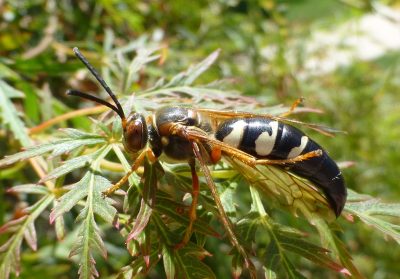
The Eastern Cicada killer, Sphecius speciosus, is one of the largest wasps in North America. It has amber wings and females are most evident in late July and early August as they burrow into sandy soils, leaving behind a squared off entrance and a sandy mound. Deep inside underground, the females have dragged paralyzed cicadas upon which they lay an egg. The larva will hatch and eat the paralyzed cicada. Next summer, after having pupated underground, the adults emerge. The females rarely sting but do alarm many homeowners due to their size and activity in lawns and along sidewalks. 

Large black-and-cream wasp perched on green, finely cut leaves in bright sunlight.
Cicada Killer. Photo by Pamm Cooper, UConn Home Garden Education Office

Grass carrying wasps Isodontia spp. create cells from grasses collected by the female. Each cell is stocked with paralyzed tree crickets, katydids and other orthoptera insects. Often packed together, these nesting cells can be found on windowsills, on bases of slider doors and on upper window ledges. Larvae overwinter in these cells and emerge as adults the following year or later that same year if there are two generations. 

The oak apple gall wasp Amphibolips spp female lays an egg inside the tissue of an oak leaf inside which the larvae will hatch. The apple-like gall forms as a response to secretions from the larvae as it feeds on the leaf tissue safely inside. The gall turns brown after the adult wasp emerges. No damage is done to the oak. Cutting open the gall when green will reveal the wasp larva in the center. 


Potter Wasp, Eumenes fraternus, females construct a small, rounded clay structure with a neck-like protuberance with a flattened top that makes it look like a tiny pot. After laying a single egg inside the female puts some paralyzed caterpillars and beetle larvae which the larva will eat. She seals the small opening with mud, which will be chewed open when the adult emerges next year. These tiny pots can be found on plants, rocks, pieces of wood and other places. 

Solitary wasps pose little risk to us as they go about completing their life’s work. Defending nests is not a behavior such as is done by social wasps and hornets. Females will sting if handled or alarmed though, so avoid doing that. If digger wasps make you nervous, consider amending sandy soil with organic matter and keeping it moist when females are looking to excavate nesting chambers. Try to tolerate them for the short period of time they are active. Almost all can be found obtaining nectar from flowers in the wild and in cultivated landscapes.  

The UConn Home Garden Education Office supports UConn Extension’s mission by providing answers you can trust with research-based information and resources. For gardening questions, contact us toll-free at (877) 486-6271, visit our website at homegarden.cahnr.uconn.edu, or reach out to your local UConn Extension Center at extension.uconn.edu/locations.       
This article was published in the Hartford Courant May 9, 2026