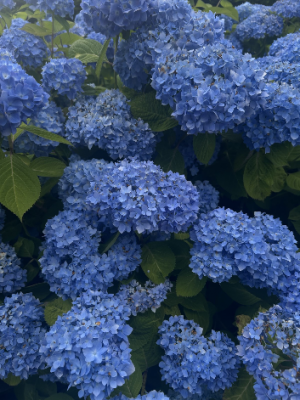
Blue is a color seldom seen in nature. Although the sky and bodies of water appear blue, very few animals and plants also exhibit this striking color. Anthocyanins, a type of pigment, are responsible for creating the red, purple, and blue hues found in plants. Anthocyanins are sensitive to environmental effects, such as acidity and the presence of metal ions. A primary example of this phenomenon is seen in the primary pigment Delphinidin, a type of anthocyanin. Delphinidin changes color in the presence of aluminum ions, which become more soluble/available in acidic environments. Bigleaf hydrangeas contain this pigment, infamously lining the neighborhoods of Connecticut in a range of pastel blues to deep fuchsia hues dependent on soil pH levels.
Other plants, such as the blue oil fern, can appear iridescent blue due to structural color. Since they are accustomed to the dim understory of the rainforest, these plants must take advantage of as much light as they can get. Many plants reflect green light the most, creating their characteristic green hue. Blue oil ferns have specialized chloroplasts on the surface of their leaves called iridoplasts, allowing the plant to capture more green light rather than reflect it. These iridoplasts create a shiny blue appearance despite no blue pigments being present. The arrangement of photosynthetic membranes in iridoplasts creates an optical nanostructure known as photonic crystals that slow down and concentrate light, ultimately allowing the plant to use available light more efficiently.
Many companies have taken the rarity of blue plants as a challenge, working to engineer a blue flower themselves. Roses, orchids, and chrysanthemums have been genetically modified in recent years to achieve this goal, but the results thus far have only yielded shades of purple. One project, the Phalaenopsis Blue Gene Orchid engineered in Japan, was recently deregulated in the United States and thus approved for sale (though not yet widely available). A Delphinidin gene was inserted from an Asiatic dayflower into a pink “Wedding Promenade” orchid. A white orchid flower, an apparent blank canvas, could not be used as a starting point because Delphinidin needs co-pigments to bind and stabilize the color—White Phalaenopsis lacks these important support molecules. The Blue Gene Orchid flowers in a deep purple-indigo, likely due to its intracellular pH and naturally occurring co-pigments that bind and alter coloration.
The easiest method, however, to acquire blue flowers may be available in your kitchen: food coloring. If you place cut flowers into a cup of water with blue food coloring (20-30 drops), the water will be sucked up through water transport tubes (xylem), giving your flowers a pleasant blue coloring. While artificial, it allows for unique customization and can be a great experiment to do with kids. White carnations and roses worked best when I attempted this for my second-grade science fair. Grocery stores selling blue flowers often use this trick via stem injection or may also paint blue coloring on the outside of the flower. While a standalone blue pigment doesn’t exist in plants, nature has found a way to create a beautiful rainbow for us to enjoy!