Web cookies (also called HTTP cookies, browser cookies, or simply cookies) are small pieces of data that websites store on your device (computer, phone, etc.) through your web browser. They are used to remember information about you and your interactions with the site.
Purpose of Cookies:
Session Management:
Keeping you logged in
Remembering items in a shopping cart
Saving language or theme preferences
Personalization:
Tailoring content or ads based on your previous activity
Tracking & Analytics:
Monitoring browsing behavior for analytics or marketing purposes
Types of Cookies:
Session Cookies:
Temporary; deleted when you close your browser
Used for things like keeping you logged in during a single session
Persistent Cookies:
Stored on your device until they expire or are manually deleted
Used for remembering login credentials, settings, etc.
First-Party Cookies:
Set by the website you're visiting directly
Third-Party Cookies:
Set by other domains (usually advertisers) embedded in the website
Commonly used for tracking across multiple sites
Authentication cookies are a special type of web cookie used to identify and verify a user after they log in to a website or web application.
What They Do:
Once you log in to a site, the server creates an authentication cookie and sends it to your browser. This cookie:
Proves to the website that you're logged in
Prevents you from having to log in again on every page you visit
Can persist across sessions if you select "Remember me"
What's Inside an Authentication Cookie?
Typically, it contains:
A unique session ID (not your actual password)
Optional metadata (e.g., expiration time, security flags)
Analytics cookies are cookies used to collect data about how visitors interact with a website. Their primary purpose is to help website owners understand and improve user experience by analyzing things like:
How users navigate the site
Which pages are most/least visited
How long users stay on each page
What device, browser, or location the user is from
What They Track:
Some examples of data analytics cookies may collect:
Page views and time spent on pages
Click paths (how users move from page to page)
Bounce rate (users who leave without interacting)
User demographics (location, language, device)
Referring websites (how users arrived at the site)
Here’s how you can disable cookies in common browsers:
1. Google Chrome
Open Chrome and click the three vertical dots in the top-right corner.
Go to Settings > Privacy and security > Cookies and other site data.
Choose your preferred option:
Block all cookies (not recommended, can break most websites).
Block third-party cookies (can block ads and tracking cookies).
2. Mozilla Firefox
Open Firefox and click the three horizontal lines in the top-right corner.
Go to Settings > Privacy & Security.
Under the Enhanced Tracking Protection section, choose Strict to block most cookies or Custom to manually choose which cookies to block.
3. Safari
Open Safari and click Safari in the top-left corner of the screen.
Go to Preferences > Privacy.
Check Block all cookies to stop all cookies, or select options to block third-party cookies.
4. Microsoft Edge
Open Edge and click the three horizontal dots in the top-right corner.
Go to Settings > Privacy, search, and services > Cookies and site permissions.
Select your cookie settings from there, including blocking all cookies or blocking third-party cookies.
5. On Mobile (iOS/Android)
For Safari on iOS: Go to Settings > Safari > Privacy & Security > Block All Cookies.
For Chrome on Android: Open the app, tap the three dots, go to Settings > Privacy and security > Cookies.
Be Aware:
Disabling cookies can make your online experience more difficult. Some websites may not load properly, or you may be logged out frequently. Also, certain features may not work as expected.
The Hartford Courant – Dr. Lauren Kurtz discusses how native plants attract birds and pollinators, while invasive species harm ecosystems and what residents can do in their own gardens.
By Heather Zidack, UConn Home & Garden Education Center
With a perfect combination of warm days, cool nights, and plenty of rain, every gardener has been fighting weeds since this summer began! To add to the frustration, the weather patterns themselves have felt like they have fallen on weekends, holidays, and all those precious hours that we love to be spending in the garden, making it difficult to get out and manage what is there. So how do we catch up?
Photo by Heather Zidack, UConn Home & Garden Education Center
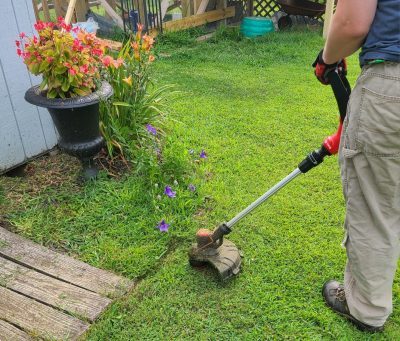
I’m sorry to say that the adage of “pick your battles” is going to be the best strategy to keep you from “getting lost in the weeds.” Mechanical removal like string trimming, mowing, or cultivating your garden are always effective. But some of us are looking for something that feels more efficient or saves our back from hours of labor-intensive weed pulling in this summer heat. Strategizing more long-term goals for your planting beds and lawns might be better for you than running outside with your garden weasel right now.
We’ve all heard “nature abhors a vacuum” before. Weeds are no different. If turf is thin, or garden beds are left with uncovered soil, weeds will pop up. Utilize groundcovers and mulches to keep soil covered. If you’re in between plantings in the vegetable garden, a temporary cover, like cardboard, may keep seeds from contacting the soil until you’re ready to plant! For more long-term coverage, consider cover crops in your vegetable gardens.
Encourage dense plantings through proper fertilizing, watering, and care. Healthy perennials and shrubs will shade out seeds that may try to germinate below them. For lawns, consider overseeding to bulk up thinned turf areas between August 15th and September 15th. Mulch garden beds and pathways with a minimum depth of 3 inches if groundcovers aren’t being used.
Once you have soil coverage under control, look at the nutrition. When the soil is not nutritionally supportive, you often find compounding issues like patches where you can never get grass to grow, poor vegetable production/flowering, and lots of weeds! Many weeds can thrive in these poor soils. While weeds aren’t necessarily a definitive indicator of a nutrient problem, it can be another clue when looking at the health of your planting areas. If you kill the weeds, and the soil remains poor you can expect weeds again the following season. Therefore, testing your soil and correcting imbalances is a long term and sustainable solution.
Some common weeds, like crabgrass, are beyond a stage where we can easily control them with methods available to the homeowner. Fear not! Crabgrass is an annual, and the plants themselves will not return next year! They, instead, propagate through seeds.
At this point in the season, shift your focus towards minimizing next year’s seed bank. As much as we loved to “make a wish” on a dandelion as children, we were only spreading more dandelions into the yard! Keep this in mind now as you tend your garden. Cut grass before weeds can develop flowers and distribute seeds. Remove plants like pokeweed, before they have a chance to develop berries that can be carried off by animals.
Don’t underestimate the value of a good identification. Knowing the exact species of weed in the garden can help you make a targeted approach with whatever physical, cultural, or chemical method you might be considering.
If you must resort to chemical management, read the label in full and follow all instructions provided. At the UConn Home & Garden Education Center we do not recommend the use of anecdotal home remedies for weeds. Many of these methods are not researched. Products used in the garden should be labeled for use on a specific host, a specific pest, and have specific application instructions. As an example, while vinegar may be recommended anecdotally to use on weeds in the garden, one should only consider a product like horticultural vinegar that has a specific formulation, concentration, and a product label that clearly identifies its uses, safety precautions, and instructions for use.
No matter what weed you are trying to manage, persistence is key. This is especially important to remember if you’re dealing with the most aggressive weeds, or even invasive plant species. Rarely do we see a single treatment leading to complete eradication. So don’t be discouraged if plants are taking multiple seasons to tackle. The CT Invasive Plant Working Group has great guidances on what you should do for specific species of invasive plants like Japanese Knotweed, Mile-A-Minute Vine, Tree of Heaven, and more.
If you have specific questions or need help with weed identification in the lawn or garden, send us pictures, or stop by with a sample.
The UConn Home & Garden Education Center supports UConn Extension’s mission by providing answers you can trust with research-based information and resources. For gardening questions, contact us toll-free at (877) 486-6271, visit our website at homegarden.cahnr.uconn.edu, or reach out to your local UConn Extension center at cahnr.uconn.edu/extension/locations.