How many times have we all heard that phrase? Humans generally do not like super humid weather, but many plants love it. Humidity may even change how a plant grows. Humidity loving plants actually NEED high humidity to grow, and they generally are not able to adapt to lower humidity. Symptoms of low humidity in plants can be leaf drop, drying leaf edges, and in some cases, death. However, with a little special attention and care, a plant enthusiast can add some very unique plants to their collection.
The summer is the easiest time to grow high humidity plants, unless an air conditioner is used. Moving the plants outside to a porch is a great way to satisfy humidity needs. The winter time is the most challenging as the air is cold and dry due to the weather and our heating systems. There are some easy ways to increase humidity in a home, however. The first is to add a humidifier, but I have found these end up causing mold issues sooner or later. A pebble tray or some other kind of tray of water set under the plants, but not touching the pot/soil, can do a fairly good job of increasing humidity. It will need to have water added once or twice a day. My favorite way of increasing humidity is by grouping a bunch of plants all together in one area. They all seem to help each other out by increasing humidity in that spot as they transpire. A fish tank or bowl of water can also increase the humidity in the room substantially. A spray bottle can be used to temporarily increase humidity, but the effects are too short-lived to be worthwhile. Placing a glass or plastic dome over a plant or a small terrarium/plant cabinet is a great way to increase the humidity permanently. Another idea is to place these plants in a humid bathroom environment where showers are taken. There are a number of really unique plants that will make for a fascinating collection if the extra humidity puzzle can be solved.
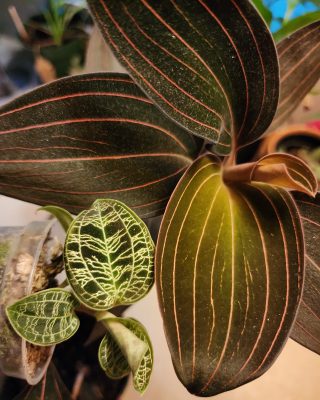
The first two plants that I absolutely love are collectively called Jewel Orchids. I have not found them to be too difficult to grow, but they do not tolerate drying out yet cannot sit in water. I place them on my nightstand next to and underneath some other more “normal” plants. The Jewel Orchid, Ludisia discolor, is an unusual plant has really dark maroon or brown leaves with reflective pink lines. The Lightning Jewel Orchid, Macodes petola, has dark green leaves with reflective yellow lines, living up to its namesake.
Many vining plants like high humidity too. Any of the common ones like Pothos (Epipremnum sp.), Philodendron, Scindapsus, and Monstera tolerate our normal home humidity well, but will grow much larger leaves when exposed to beneficial high humidity. A more difficult plant is Cissus discolor, and words cannot fully describe its beauty. The leaves have a pattern of green, marron, pink, and white in them that is unbelievably gorgeous. This one is so difficult to overwinter that many times I end up taking cuttings of the vines and putting them under a dome. I mist inside the dome frequently and in the spring, I start over by potting the cuttings up in a hanging basket. For a blooming vine, try the bleeding heart vine, Clerodendrum thomsoniae, with its white and red flowers.
The genus Labisia has some mind-blowing, incredible colors and patterns. These plants are expensive, but worth a try. Anthurium, Alocasia, and Syngonium generally have arrow or heart shaped leaves. They have some very unique patterns and shapes, but they do struggle and die if the humidity drops. The prices are all over and just depend on the variety. Other foliage plants include Begonia rex with all sorts of colors and patterns or Fittonia with red, pink, or white stripes on green leaves. Why not try taking the houseplant hobby to the next level by adding some humidity loving plants?
The UConn Home Garden Education Office at the George Leigh Minor Plant and Soil Health Center supports UConn Extension’s mission by providing answers you can trust with research-based information and resources. For gardening questions, contact us toll-free at (877) 486-6271, visit our website at homegarden.cahnr.uconn.edu, or reach out to your local UConn Extension office at extension.uconn.edu/locations.