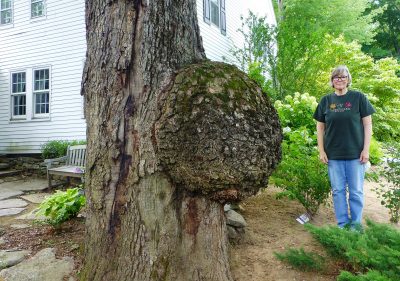
Burls are sound, hard, woody swellings or protrusions that form on the trunks, branches, or roots of trees. They often appear as rounded or ridged masses with normal bark tissue. Burls are benign and are the result of a response in growth to outside stresses. The normal bark texture of the tree will be on the exterior surface of the burl.
The exact cause of burl formation is a mystery, but these growths are formed by abnormal cell proliferation by the xylem. This growth can be triggered by stress factors such as environmental injury, insect feeding damage, or infections from fungal or bacterial pathogens. Some are thought to be the result of genetic factors that trigger abnormal growth without outside influences. Most burls are not causes of concern to the health of otherwise normally growing trees. Removal of burls from trees is not recommended as it will cause more harm than if the burl remains on the tree.
Some tree species seem to have more burls than others. In our area oaks, maples, willows, cherry and elms have more of a tendency to form burls than other tree species. Sometimes small groups of the same tree species in a tight area may all have burls. Whether the cause is environmental, genetic or both would require a good amount of research. Even then, the root cause may be impossible to discover.
Recently, a friend showed me a tree with one of the largest burls I have seen. This tree was located about a mile into the woods and was a good distance from the trail, but easily visible. It was almost five feet high and went almost completely around the trunk of the mature tree it was growing on.
Because of the nature of unique formation and structure of burls, grain formation is unusual, creating swirling patterns that can be very beautiful. A bird’s eye pattern is the result of an aborted adventitious bud. This makes wood galls a highly prized find by woodworkers, who use the wood especially for veneers and bowls.
There are woody galls caused by gall- forming mites, wasps or by fungal pathogens that are sometimes mistaken for burls. These include the black knot galls that form on infected black cherry and other Prunus species and are caused by a fungal pathogen, as well as horned galls on oaks that result from feeding by gall wasps. These types of growths can be harmful to the host tree.
To tell if an abnormal growth on a tree is a burl or a gall, compare the outer surface and texture of the growth. Burls have smooth, rounded surfaces that are fully covered in bark. The tissue is solid wood and will have intricate, swirling grain patterns. Galls typically have a rough texture to their surface, somewhat tumor-like and with vertical or horizontal ridges. The interior is not solid wood, but instead may be papery, pulpy or otherwise somewhat softer than the wood and is usually discolored. If cut open, there may be a wasp larva or a mite inside the gall. While both a gall and a burl result from excessive cell division, the causes are very different.
If you want to learn more, a good article on tree burls can be found on this link from the University of New Hampshire written by forestry field specialist Greg Jordan.
The UConn Home Garden Education Office supports UConn Extension’s mission by providing answers you can trust with research-based information and resources. For gardening questions, contact us toll-free at (877) 486-6271, visit our website at homegarden.cahnr.uconn.edu, or reach out to your local UConn Extension center at extension.uconn.edu/locations.