Garden centers and other retail stores have fruit trees for sale now, and in some instances, the price is too good to pass up. But before you run out and buy fruit trees, there are some things you need to consider before purchasing. First and foremost, consider whether you will need more than one tree, or variety of tree, to ensure good cross-pollination.
Peaches, tart cherry, and apricots are self-fruitful and do not need another variety in order to pollinate well. A single tree will produce fruit if all environmental conditions are adequate. But most sweet cherries and pears will not produce much fruit unless the proper cross-pollinator variety is nearby. For example, if you want Bartlett pears, then you will also need another pear variety- d’Anjou, Bosc, or Comice- to ensure proper pollination and good fruit yield.
Providing a cross-pollinator with apples is especially tricky. They are self-unfruitful and require another variety of apple whose flowering period overlaps with it to ensure optimum pollination of the flowers. Pollinator requirements are often not well- understood by novice gardeners who are planning to grow apples for the first time. Many people make the mistake of only buying the apple trees they want for fruit, such as MacIntosh, and they do not realize they will need one more variety of the correct cross-pollinator to get fruit of an acceptable amount.
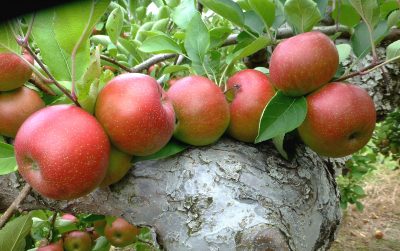
Apples belong to one of three groups- early, mid, and late-season -blooming. So early and mid-season blooming varieties will provide adequate cross-pollination and fruit set with each other, while mid and late-season varieties will do the same. A late blooming variety then will not provide cross-pollination with an early blooming variety. Conversely, an early blooming variety will not help a late- blooming variety cross-pollinate. The mid-season flowering varieties can be effective cross-pollinators of both the early and late-season varieties.
Note: if there are flowering crabapples nearby that flower at the same time as the apple variety you have, then cross-pollination can be sufficient. Crabapple flowers attract diverse bees and other pollinators. If you already have an ornamental crabapple that flowers when your apple tree does, that will likely be sufficient to ensure good pollination of your apple tree. Apple varieties like Jonathan, Jonagold, Golden Delicious, Gal and several are listed a self-fruitful, but they will set more fruit if cross-pollinated.
To simplify a gardener’s efforts to get the best cross-pollinators for their fruit trees, there are charts available that can be printed and brought to the garden center or nursery that will help in fruit tree selection. If you find a fruit tree variety you really like, do a little research before buying it see whether another variety will be needed for cross-pollination or not. For a good fact sheet that explains the ins and outs of fruit tree pollination there is valuable information on the following link:
https://extension.missouri.edu/publications/g6001
I hope we have a great fruit growing year here in Connecticut. May the pollinators and good weather be with us.
The UConn Home Garden Education Office supports UConn Extension’s mission by providing answers you can trust with research-based information and resources. For gardening questions, contact us toll-free at (877) 486-6271, visit our website at homegarden.cahnr.uconn.edu, or reach out to your local UConn Extension Center at extension.uconn.edu/locations.