Fruit

Look Before You Leap Before Buying Fruit Trees

By Pamm Cooper, UConn Home Garden Education Office

Garden centers and other retail stores have fruit trees for sale now, and in some instances, the price is too good to pass up. But before you run out and buy fruit trees, there are some things you need to consider before purchasing. First and foremost, consider whether you will need more than one tree, or variety of tree, to ensure good cross-pollination.  

Peaches, tart cherry, and apricots are self-fruitful and do not need another variety in order to pollinate well. A single tree will produce fruit if all environmental conditions are adequate. But most sweet cherries and pears will not produce much fruit unless the proper cross-pollinator variety is nearby. For example, if you want Bartlett pears, then you will also need another pear variety- d’Anjou, Bosc, or Comice- to ensure proper pollination and good fruit yield.  

Providing a cross-pollinator with apples is especially tricky. They are self-unfruitful and require another variety of apple whose flowering period overlaps with it to ensure optimum pollination of the flowers. Pollinator requirements are often not well- understood by novice gardeners who are planning to grow apples for the first time. Many people make the mistake of only buying the apple trees they want for fruit, such as MacIntosh, and they do not realize they will need one more variety of the correct cross-pollinator to get fruit of an acceptable amount.  
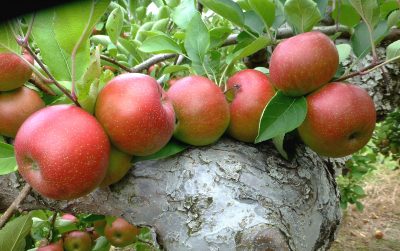
Cluster of red apples growing closely together along a thick tree branch, surrounded by green leaves.
Photo by Pamm Cooper, UConn Home Garden Education Office

Apples belong to one of three groups- early, mid, and late-season -blooming. So early and mid-season blooming varieties will provide adequate cross-pollination and fruit set with each other, while mid and late-season varieties will do the same. A late blooming variety then will not provide cross-pollination with an early blooming variety. Conversely, an early blooming variety will not help a late- blooming variety cross-pollinate. The mid-season flowering varieties can be effective cross-pollinators of both the early and late-season varieties.  

Note: if there are flowering crabapples nearby that flower at the same time as the apple variety you have, then cross-pollination can be sufficient. Crabapple flowers attract diverse bees and other pollinators. If you already have an ornamental crabapple that flowers when your apple tree does, that will likely be sufficient to ensure good pollination of your apple tree. Apple varieties like Jonathan, Jonagold, Golden Delicious, Gal and several are listed a self-fruitful, but they will set more fruit if cross-pollinated.  

To simplify a gardener’s efforts to get the best cross-pollinators for their fruit trees, there are charts available that can be printed and brought to the garden center or nursery that will help in fruit tree selection. If you find a fruit tree variety you really like, do a little research before buying it see whether another variety will be needed for cross-pollination or not.  For a good fact sheet that explains the ins and outs of fruit tree pollination there is valuable information on the following link:  

https://extension.missouri.edu/publications/g6001 

I hope we have a great fruit growing year here in Connecticut. May the pollinators and good weather be with us. 

The UConn Home Garden Education Office supports UConn Extension’s mission by providing answers you can trust with research-based information and resources. For gardening questions, contact us toll-free at (877) 486-6271, visit our website athomegarden.cahnr.uconn.edu, or reach out to your local UConn Extension Center atextension.uconn.edu/locations.    

This article was published in the Hartford Courant April 12, 2026

End of Season Strawberry Renovation

By Dawn Pettinelli, UConn Home & Garden Education Center

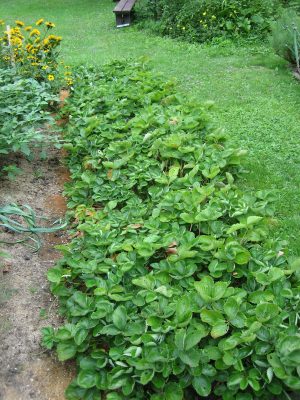
Strawberry row
Strawberries before renovation at the end of the season. Photos by dmp2024

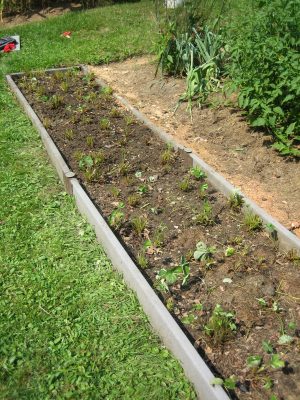
Strawberry row after renovation
Strawberries after renovation at the end of the season. Photos by dmp2024

So, you decided to grow some strawberries this year. You carefully prepared the bed and have enjoyed your first crop. Now you are wondering what to do to keep your strawberry bed healthy and productive. In part, the care after harvest depends on whether you are growing June bearing or day neutral (everbearing) varieties and what kind of row systems you have them planted in.

June bearing strawberries are most commonly grown in what is known as the matted row system. Mother plants are set 18 to 24 inches apart in 3 to 4 1/2 foot rows and runners are allowed to root anywhere within the row. This system is usually the easiest to maintain. Typically, at the end of the third growing season both plant quality and fruit quantity start to decrease and the whole bed is dug up and replanted with new disease-free strawberry plants. Try to incorporate this into your garden rotation plan to reduce disease problems.

June bearers can also be grown in single rows composed of different aged plants with the original plants set about a foot apart. A second row is started with first year runners and set 18 inches from the initial planting. Use only the first or second daughter plants produced along the runners because they are the most vigorous and productive. The rest are usually discarded.

The next year a third row is made again using the first one or two daughter plants and once more surplus runners and plants are removed. After the original mother plants have produced fruit for about 3 years, they are generally replaced with new, disease-free stock and the cycle continues. This way one always has a row or two of strawberries in production. Ideally the row with the new strawberry plants should be located on a section of the garden where strawberries haven’t been grown for 3 to 5 years. This isn’t always possible in small yards, which is why it is important to purchase certified virus free stock.

After year two when June bearing strawberries have finished producing their crop, it is time to renovate. According to Evan Lentz, UConn Fruit Specialist and Assistant Extension Educator, renovating your June-bearing strawberries is one of the best ways to maximize your annual production, reduce disease instance, and maintain an orderly planting. Proper renovation ensures that you set yourself up for success in the following year and allows you to extend the life and productivity of this semi-perennial crop. This is doubly important for individuals producing fruit in an organic or no-spray system.

This can be done sometime in July through August. Lentz suggests starting by either mowing or clipping with hand trimmers all the foliage about 2 inches or so above the crowns. Next, go through the bed removing all weeds, and weak and extra strawberry plants and dead or dying leaves. Thin to space plants at least 10 to 12 inches apart and cultivate around these remaining plants.

Now is the time to fertilize your strawberries whether beds are renovated or not. Lentz recommends working in about 3 to 4 pounds of 10-10-10 or its organic equivalent per 100 square feet. Lightly scratch the fertilizer into the soil. Brush or rinse any fertilizer off leaves at the salts will injure them.

Day neutrals, such as ‘Tristar’, ‘Seascape’ and ‘Mara des Bois’ produce a fairly decent size crop in June and continue forming occasional berries until frost. Unlike June bearers which develop fruit buds in late summer and early fall, the ever bearers have the ability to form fruit buds throughout the summer. An advantage to growing day neutrals is you will still get strawberries even if a late spring frost kills their initial fruit buds.

In general, day neutrals are grown for 2 or 3 years and then a new batch of strawberries is planted. The day neutrals produce far fewer runners than the June bearers. The new daughter plants should all be removed although they can be transplanted into another area if desired. Plants are usually set one foot apart in single rows about 18 inches wide.

According to Lentz, all strawberries require at least an inch of water per week for vigorous growth. If dry weather sets in, plan on irrigating plants, especially those just renovated. Use a mulch of pine needles, straw or wood shavings to conserve moisture, keep weeds down and berries off the soil. Since strawberries are shallow rooted, it is important to keep weeds under control.

It does take a little time to maintain a strawberry bed but the luxury of picking your own berries for strawberry shortcake, jam or fresh eating makes it all worthwhile. If you have questions about growing strawberries or on any other home or garden topic, contact the UCONN Home & Garden Education Center, toll-free, at (877) 486-6271, visit their web site at www.homegarden.cahnr.uconn.edu or contact your local Cooperative Extension Center.