Native Plants

Beyond Native Plants: Improving Wildlife Habitat in Managed Landscapes

By Dr. Lauren Kurtz, UConn Home Garden Education Office

Lush backyard garden bordering a weathered wooden pool deck, with yellow and orange flowering plants, shrubs, large rocks, and a black chain-link fence in front of a wooded area. A swimming pool is visible on the right, with landscaped beds extending along the deck.
Photo by Lauren Kurtz

There is growing interest in using home landscapes as habitat for local wildlife. Ecological landscaping goes beyond pollinator gardens and wildflower meadows. It incorporates native plant selection, species specific habitat features, and sustainable maintenance practices. By designing landscapes with an ecological mindset, we can support wildlife while creating attractive, functional yards. 

Ecological landscaping models natural plant communities, reduces chemical inputs, and supports soil health to increase local biodiversity. Natural ecosystems are complex and dynamic, whereas traditional home landscapes are often neat and predictable. Ecological landscaping requires us to change both how we manage and how we think about our landscapes. With thoughtful design and maintenance, we can create yards that are both aesthetically pleasing and ecologically beneficial. Several key practices can help gardeners support the ecosystem in their own yards. 

Start with Native Plants 

Native plants are the foundation of the local food web. Incorporating more native plants into managed landscapes increases the food supply available to local wildlife. Native plants serve a dual purpose: they are ecologically valuable and ornamental. 

Choose plants suited to site conditions and compatible with the surrounding plant community. Select a variety of species that bloom in spring, summer, and fall to provide color and pollinator forage throughout the growing season. Include native plants that serve as larval host plants for insects and create layered vegetation with different heights and forms to provide habitat from the soil surface to the canopy. 

Add Habitat Features 

Beyond native plants, healthy ecosystems require other habitat features. Leaving plant debris and leaves in garden beds provides soil cover and protection for overwintering animals. Species differ in their overwintering shelter needs, consider which wildlife you hope to attract and tailor habitat features accordingly. 

Leaving brush piles, dead wood, or snags is another important way to provide shelter. In general, reducing or skipping fall cleanup and delaying spring cleanup benefits wildlife. However, balance these practices with the needs of the landscape. For example, a thick layer of leaves left on a turf lawn through winter can smother grass and create dead patches; move those leaves into garden beds instead. 

Reduce Chemical Inputs 

Reducing chemical inputs is another critical component of ecological landscaping. Chemical inputs include fertilizers, herbicides, fungicides, and insecticides. Even natural or organic pesticides should be reduced or eliminated in an ecologically minded garden. Reducing these inputs allows the natural balance of the ecosystem to return. 

Gardening for food production may require different maintenance practices and a greater allowance for chemical inputs than gardening primarily for wildlife habitat. The same is true for managing invasive plants, which may require targeted herbicide use.  

Balance Ecology and Aesthetics 

There is a balancing act between ecological maintenance practices and maintaining an attractive landscape. Leaving leaves and plant debris in place can be an adjustment for gardeners new to ecological landscaping. Still, ecological landscaping does not require abandoning attractive or usable spaces. Thoughtful design, intentional maintenance, and a willingness to relinquish some control can benefit both nature and people in the long run. 

Interested in getting a jump start on applying ecological landscaping practices to your garden this year? Join us for a webinar on this and more fall cleanup topics on October 20th. Visit s.uconn.edu/hgeo-webinars for registration and details. 
The UConn Home Garden Education Office at the George Leigh Minor Plant and Soil Health Center supports UConn Extension’s mission by providing answers you can trust with research-based information and resources. For gardening questions, contact us toll-free at (877) 486-6271, visit our website at homegarden.cahnr.uconn.edu, or reach out to your local UConn Extension center at extension.uconn.edu/locations. 

This article was published in the Hartford Courant October 19, 2026

Invasive or Aggressive? Why the Difference Matters in Your Garden

By Dr. Lauren Kurtz, UConn Home Garden Education Office

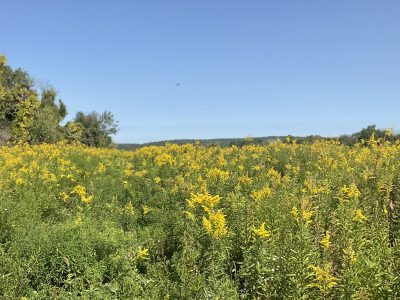
Wide meadow filled with tall yellow wildflowers under a clear blue sky, bordered by trees and distant low hills in the background.
Canada goldenrod (Solidago canadensis) is an aggressive, native plant. Photo by Lauren Kurtz

You’re in the garden, staring at that same patch of weeds spreading year after year into your flower beds. You grumble how invasive they are. Or are they aggressive? Conversationally, both invasive and aggressive paint the same picture but if you read the fine print, they mean different things.

In everyday conversation, the two words can sound interchangeable. In horticulture and ecology, however, they mean different things. That distinction can shape how we manage plants, communicate with other gardeners and landscape professionals, and understand the regulations that apply to certain species. Gardening lingo can be nuanced and details matter.

Let’s begin with the broadest term: weed. A weed is simply a plant growing where it is not wanted. A weed may be otherwise desirable when it’s growing where we want it. Ralph Waldo Emerson famously said a weed is “a plant whose virtues have not yet been discovered.” A weed is more a description of where a plant is growing; it does not give away information about the plant’s provenance or growth habit.

Aggressive describes the growth behavior of a plant. Weeds and plants we grow in our gardens can be aggressive. Native and nonnative plants can be aggressive too. Aggressive plants can outcompete other plants for resources and outgrow the space allotted to them. Not all aggressive plants are invasive, but in some cases an aggressive, non-native plant can be categorized as invasive.

Invasive plants are nonnative and have demonstrated the ability to spread aggressively, establish outside of cultivation into natural areas, and outcompete native plants. People have introduced plants beyond their native ranges for centuries both intentionally and unintentionally. Most introduced, nonnative plants do not become invasive, but those that do can cause significant, costly problems for landowners, communities, and land managers. Invasive plants often have legal or regulatory implications.

The way invasive plants are regulated varies state to state. In Connecticut, a plant is considered invasive if it meets a set of ecological criteria outlined in Connecticut General Statutes 22a-381a. Connecticut’s Invasive Plants Council uses these criteria to recommend which plants belong on the state’s invasive plant list. The list is periodically updated by the State legislature as additional plants meeting the invasive plant criteria are identified. There are more than 100 plants on Connecticut’s invasive plant list.

What does it mean for a plant to be native or nonnative? Native plants are species that have occurred in a region without the benefit of human introduction. Depending on the context, native can mean native to the United States, to New England, to Connecticut, or to a smaller locale. There are different opinions about what makes a plant native and at what geographic scale. The most important consideration is that native plants coevolved alongside other species in their native range and are part of the greater ecological community. Native plants can be considered aggressive, but they are not considered invasive.

In summary, what defines a weed is a matter of opinion. Aggressive plants have robust growth, can be native or nonnative, and are sometimes further classified as invasive. All invasive plants are nonnative and are usually aggressive.

The UConn Home Garden Education Office at the George Leigh Minor Plant and Soil Health Center supports UConn Extension’s mission by providing answers you can trust with research-based information and resources. For gardening questions, contact us toll-free at (877) 486-6271, visit our website at homegarden.cahnr.uconn.edu, or reach out to your local UConn Extension center at extension.uconn.edu/locations. 

This article was published in the Hartford Courant August 16, 2026

These are damaging plants to avoid in CT gardens. They can kill native plant species and take over.

These are damaging plants to avoid in CT gardens. They can kill native plant species and take over.

The Hartford Courant – Dr. Lauren Kurtz discusses how native plants attract birds and pollinators, while invasive species harm ecosystems and what residents can do in their own gardens.