Soils

What to Know Before You Buy Topsoil

By Dr. Avishesh Neupane, UConn Soil Analysis Lab

The word topsoil suggests rich, dark earth that will fix most of what ails a yard. Maybe the lawn never recovered after construction, a new raised bed needs filling, or a bare patch by the driveway still looks more like gravel than garden. Buying a load of topsoil seems like a simple answer to all three. 

But "topsoil" is not a guarantee of quality. Depending on the source, it may be dense, low in organic matter, full of stones, or simply a poor match for the job you have in mind. That means homeowners should buy it with a clear idea of what it can and cannot do. 

The first question is not what to buy, but what problem you are trying to solve. If the real issue is low pH, low fertility, or some other imbalance, another load of soil may not help much. A soil test is an inexpensive way to check pH and nutrient levels before you start adding products. 

If you are filling a new raised bed, topsoil alone is usually not the best answer. A blend of topsoil and finished compost works better than straight compost or straight mineral soil, because the two materials do different jobs. Topsoil provides mineral content, structure, and weight. Compost adds organic matter, holds moisture, and improves tilth. Most unamended topsoil is low in organic matter, which is why a topsoil-compost blend is usually more useful for gardens and landscapes. 

There is no state-run topsoil grading or certification system in Connecticut, so buyers have to ask a few questions on their own. Where did the soil come from? Has it been screened? Is it meant for lawn repair, general grading, or a vegetable garden? Is compost already mixed in, and if so, how much? These answers matter because soil products are not interchangeable: material sold for grading can be fine for filling low spots but a poor choice for a vegetable bed. 

It is also worth thinking about what might come along for the ride. Poorly sourced soil can carry contaminants that are not obvious to the eye, including residues from past land use. Ask the supplier about the soil's origin, and if there is reason for concern, have it tested for lead or pesticide residues before planting. If the product includes compost, ask whether it comes from a reputable testing program, such as the U.S. Composting Council's Seal of Testing Assurance, which requires routine testing for heavy metals and pathogens. There is a biological concern as well. Invasive jumping worms and their cocoons can hitch a ride in soil, compost, mulch, and potted plants, so buying from reputable sources and using heat-treated compost or mulch when possible can help reduce that risk. 

Texture is another simple check. If the material feels sticky and heavy when wet, it may seal up and drain poorly. If it feels very light, peaty, or woody, it may settle quickly after a season or two. Good garden soil, or a good topsoil-compost blend, should crumble easily, drain reasonably well, and still hold moisture. It should smell earthy, not sour or strongly ammonia-like. 

Cost deserves a clear-eyed look as well. Bulk soil is usually cheaper than bagged soil and creates less plastic waste, but the cheapest load may not be the best buy if it leaves you with hard, low-organic-matter material that won't support plant growth well. 

There is one more caution, mainly for gardeners who refresh beds every year. Building organic matter in a tired soil is a good idea, but more compost and manure are not always better over the long run. Repeated heavy additions, especially of manure-based compost, can push phosphorus levels well above what plants can use. That is a problem for water quality if the soil erodes, and it can throw off the balance of other nutrients. A periodic soil test is the best way to know whether a bed actually needs more material. 

For most homeowners, the best results come from matching the material to the job. Test first if you can. Use topsoil for structure and volume, compost for organic matter, and each where it makes sense. For a raised bed, start with a soil-compost blend. To repair a lawn after construction, plan to build organic matter over time with compost, mulch, and returning grass clippings or shredded leaves to the soil. When buying from a bulk supplier, ask questions before the truck shows up. 

Topsoil can be a useful tool, but it is still only one ingredient. Better soil is built, not delivered in a single truckload. 

The UConn Home Garden Education Office supports UConn Extension’s mission by providing answers you can trust with research-based information and resources. For gardening questions, contact us toll-free at (877) 486-6271, visit our website athomegarden.cahnr.uconn.edu, or reach out to your local UConn Extension Center atextension.uconn.edu/locations.       

This article was published in the Hartford Courant May 17, 2026
Watch Out for These Nutrient Deficiency Symptoms

Watch Out for These Nutrient Deficiency Symptoms
By Haiying Tao, Ph.D., UConn Home & Garden Education Center

Plants need at least seventeen essential nutrients to complete their life cycles. Scientists group these essential nutrients into macronutrients (carbon, hydrogen, oxygen, nitrogen, potassium, phosphorus, sulfur, calcium and magnesium), which are required in large quantities and micronutrients (zinc, iron, copper, boron, manganese, chlorine, molybdenum and nickel) which are required in small quantities. Sufficient amounts of these nutrients are required in order for plants to produce well. If there is a deficiency of any essential element, yield and quality can be reduced. Alternatively, too much of a nutrient can be toxic to plants. Diagnosing nutrient deficiencies and toxicities is important for both growers and gardeners to ensure optimum harvests.

When low in an essential nutrient, plants exhibit distinct visual symptoms, which often allows us to distinguish which nutrient is deficient. A first step in diagnosing nutrient deficiencies is to describe what the symptoms look like. Symptoms caused by nutrient deficiencies are generally grouped into five categories: 1) stunted growth; 2) chlorosis or yellowing; 3) leaf spots; 4) purplish-red coloring; and 5) necrosis or death of plant parts.

The next step is to identify whether the deficiency symptoms appear on older (lower) leaves or younger (upper) leaves first. If the deficiency symptoms appear on older leaves first, then the deficiency symptoms are possibly caused by one of the nutrients that are mobile in plants, such as nitrogen, phosphorus, potassium, magnesium, chlorine, or molybdenum. In contrast, deficiency of nutrients that are immobile (calcium, sulfur, boron, copper, iron, zinc, manganese, nickel), the symptoms first appear on younger or upper leaves.

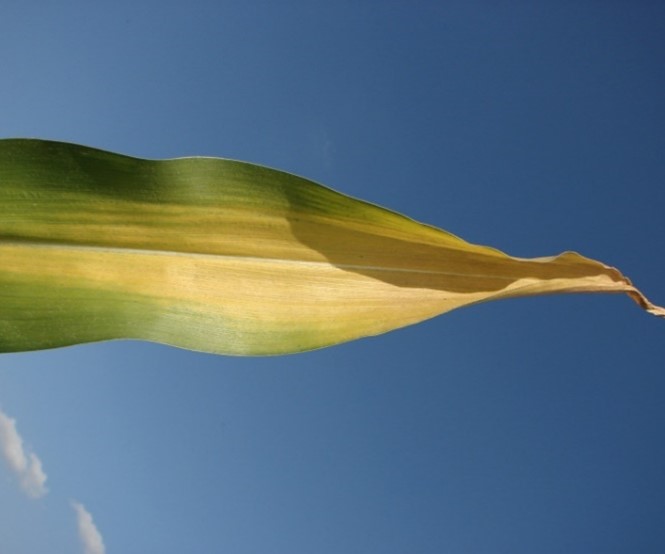
Nitrogen deficiency on corn leaf.
Nitrogen deficiency on corn leaf. Photo by Dr. Haiying Tao

Nitrogen deficiency symptoms include yellowing of the lower leaves (chlorosis), stunted and slow growth, and death of older leaves in severe cases. Nitrogen deficient plants will mature early, and the crop quality and yield are often reduced.

Phosphorus deficiency symptoms occur in the older leaves first and typical deficiency symptoms are purpling of leaves and leaf margins and stunted growth. Plants that are deficient in phosphorus are generally weak and maturity is delayed.

Potassium deficiency symptoms first appear on older leaves. Typical deficiency symptoms are yellowing and necrosis of the leaf margins. When potassium deficiency is severe, older leaves turn yellow with brown dead tissue around the edges, but the upper new leaves may stay green. Sometimes one may confuse potassium and nitrogen deficiency because both show yellowing on older (lower) leaves first. The difference is that the chlorosis starts from the tip and progresses along the ribs of the leaf if nitrogen is deficient, but the chlorosis starts from the tip and progresses along the edge of the leaf if potassium is deficient.

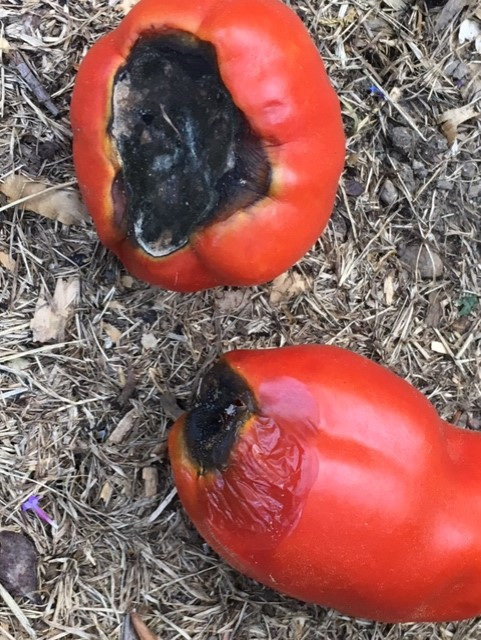
Blossom End Rot on Tomato
Blossom End Rot on Tomato. Photo by dmp2024

Another nutrient that is commonly found deficient is calcium. Typical calcium deficiency symptoms are poor leaf expansion, curling followed by necrotic patches in the young leaves. Calcium deficiency can cause misshapen fruit and aborted buds. If you find the tip of tomatoes or peppers rotting, cavity spot in carrots, and black heart in peanuts and celery, it’s likely the plants are calcium deficient. However, don’t hurry to apply calcium fertilizers. Check on other stresses such as drought because lack of moisture in the soil can lead to insufficient uptake and transportation of calcium within plants, which leads to symptoms similar to calcium deficiency.

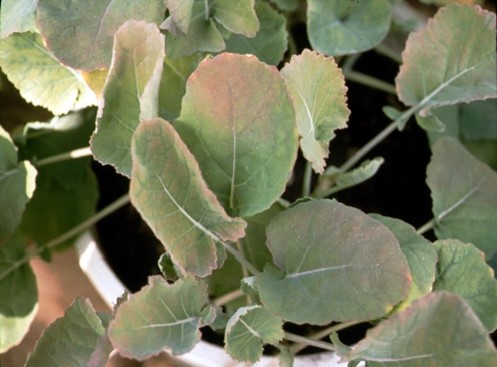
In sandy and low organic matter soils, sulfur deficiency can occur. Typical sulfur deficiency symptoms are reduced growth rate with plants becoming stunted and thin stemmed. In cole crops (such as cabbage, broccoli, etc.), discoloration appears in younger leaves first. Symptoms may include light green or yellow leaves, a reddish coloration on the undersides of leaves as well as leaves that are cupped inward.

Sulfur deficiency in cabbage.
Sulfur deficiency in cabbage. Photo by Dr. Haiying Tao

It is not always easy to identify nutrient deficiencies just by looking at a plant because the symptoms of several deficiencies are similar in appearance. Also, more than one nutrient may be deficient. It is not uncommon for other stresses such as disease, drought, excess water, genetic abnormalities, herbicide and pesticide residue injury, insects or salt injury may cause symptoms that are similar to nutrient deficiency. The best way to confirm if you have nutrient deficiency is to test your soil and plant tissue.

For questions on nutrient management in the garden or farm, feel free to contact the UConn Soil Lab at (860) 486-4271. For all your other gardening questions, contact the UConn Home & Garden Education at (877) 486-6271 or homegarden.cahnr.uconn.edu or your local Cooperative Extension Center.

Dr. Tao is an Assistant Professor and Soil Fertility Specialist in the UConn Department of Plant Science & Landscape Architecture.